I travel a lot for coaching, and one thing I’ve noticed: the best sessions happen when both of us are quiet. Not awkward-silent. The kind of stillness where everything just clicks.
That click has a name in neuroscience. It’s called coherence — billions of neurons firing together in rhythm, like an audience that suddenly starts clapping as one.
The short answer: your brain waves are not just a sleep thing. They shape how you focus under load, how well you recover between sessions, and whether stress stays manageable or takes over completely. The research says we can influence them with deliberate practice. Here’s the practical part.
What Brain Waves Actually Are
An EEG measures electrical activity on the scalp using 19 electrodes. A single electrode captures synaptic action averaged across roughly 100 million to 1 billion neurons (Nunez & Srinivasan, 2006). So when brain wave patterns shift on a readout, billions of neurons are changing how they fire.
There are five basic frequencies. Each one does something distinct for your body and mind.
Gamma (40 to 100 Hz)
Gamma is the fastest brain wave. It shows up when you’re learning, connecting ideas across different parts of your brain, or integrating complex information.
Monks meditating on compassion produced gamma flares so large they were the biggest ever recorded (Davidson & Lutz, 2008). Novice meditators showed similar baseline activity, but when the experienced monks focused on compassion, their brains fired in rhythmic coherence — like that audience suddenly clapping together.
Gamma is associated with high-level intellectual function, creativity, peak states, and feeling “in the zone.” The waves travel from front to back of the brain about 40 times per second (Llinaís, 2014) and are considered a neural correlate of consciousness — a bridge between measurable brain activity and subjective experience (Tononi & Koch, 2015).
Here’s what matters for your body. At 75 Hz, gamma is epigenetic — it triggers genes that produce anti-inflammatory proteins (De Girolamo et al., 2013). At 50 Hz, the body increases stem cell production, those blank cells that become muscle, bone, skin, or other specialized tissue (Ardeshirylajimi & Soleimani, 2015). At 60 Hz, gamma regulates stress-gene expression — including the genes coding for cortisol. That same frequency activates Myc, a key gene regulating around 15 percent of all other genes in the body (Lin, Goodman, & Shirley-Henderson, 1994).
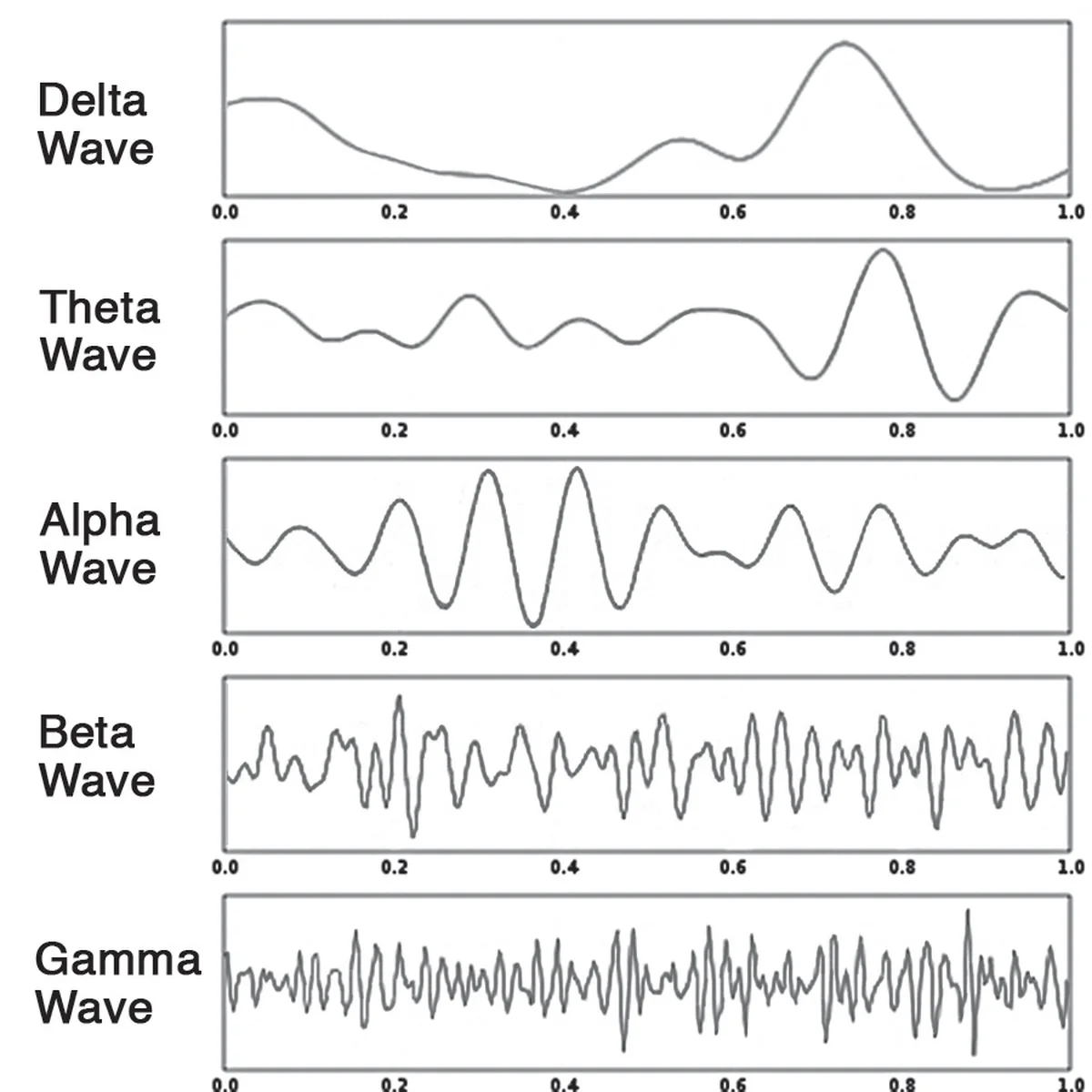
Beta (12 to 40 Hz)
Beta is your working brain. It handles information processing and linear thinking — solving a problem, calculating route options, balancing a checkbook.
But beta splits into two modes. Low beta (12 to 15 Hz), also called sensorimotor rhythm or SMR, synchronizes automatic body functions. High beta (15 to 40 Hz) is what researchers call “monkey mind.” It’s the signature wave of anxiety, frustration, and stress.
The more stressed you get, the higher beta amplitude climbs. Negative emotions — anger, fear, blame, guilt — produce large beta flares on EEG readouts. And here’s the practical part: blood flow to the prefrontal cortex drops by up to 80 percent (LeDoux, 2002). When that happens, your ability to think clearly plummets because the thinking brain is starved of oxygen and nutrients.
Normal beta levels are fine. Stress above 25 Hz is what creates problems.
Alpha (8 to 12 Hz)
Alpha is relaxed alertness — not sleepy, not wired. It sits right in the middle of the spectrum and connects the higher frequencies (beta and gamma) with the lower ones (theta and delta).
It also does tangible things for your body. Alpha boosts mood-enhancing neurotransmitters like serotonin. When exercisers increased their alpha levels, they got a serotonin boost along with an elevated emotional state (Fumoto et al., 2010). Zen meditators found the same benefits from cultivating an alpha state (Yu et al., 2011).
A study exposing DNA to different brain wave frequencies found that 10 Hz significantly increased DNA synthesis (Takahashi, Kaneko, Date, & Fukada, 1986).
Theta (4 to 8 Hz)
Theta is the frequency of deep relaxation and light sleep. It dominates during REM — when we dream vividly and our eyes move rapidly. Theta also shows up in people under hypnosis, healers, people in trance states, and those in highly creative moments.
Recalling emotional experiences, both positive and negative, can trigger theta.
Researchers studying how different frequencies affect DNA repair found that electromagnetic fields between 7.5 Hz and 30 Hz enhance molecular bonding (Tekutskaya, Barishev, & Ilchenko, 2015). Within that range, 9 Hz proved most effective.
Delta (0 to 4 Hz)
Delta is the slowest wave and the signature of deep, dreamless sleep. It dominates during non-REM sleep — when your eyes don’t move.
Very high delta amplitudes appear in people who report mystical experiences: a sense of connection with nature, other people, something larger than themselves. Albert Einstein called it overcoming “the delusion of separateness.”
Delta is not just a subjective feeling. When your brain produces this frequency, you’re creating an energy environment that grows telomeres, boosts growth hormone levels, regenerates neurons, and sweeps the brain clear of beta-amyloid plaques.
The Awakened Mind: Connecting All Five Frequencies
Maxwell Cade was a biophysicist who worked on radar for the British government before turning to measuring consciousness. In 1976, he built his own EEG machine — the “mind mirror” — which gives a clear visual snapshot of brain waves.
Cade noticed something consistent over 20 years and more than 4,000 recordings from people with strong spiritual practices: they all had high amounts of alpha. Because alpha sits in the middle of the spectrum, it forms a bridge between beta and gamma above, and theta and delta below. He called this the alpha bridge.
The Awakened Mind state has enough alpha to link all five rhythms together. High beta is minimized — so little monkey mind and anxiety. Gamma and theta are balanced. Delta forms a wide base.
How This Connects to Training
Here’s what I tell my clients: stress does not just live in your head. It shows up as high beta, which cuts blood flow to the prefrontal cortex by up to 80 percent. When that happens, form breaks down, decision-making slows, and recovery quality drops.
The flip side is just as real. Navy SEALs use advanced EEG equipment in a facility called the “Mind Gym” in Norfolk, Virginia, to train themselves into a state they call ecstasis — a flow state where super-performance becomes possible (Cohen, 2017). Once they shift into it, their prefrontal cortex quiets down. Beta-wave mental chatter stops. Neurotransmitters like serotonin, dopamine, anandamide, and oxytocin flood in.
The research on performance gains from these states is striking: a 490 percent improvement in mental focus, doubled creativity, and a 500 percent increase in productivity (Kotler & Wheal, 2017).
Elite courtroom lawyers, Olympic athletes, and Google executives train for the same state. If peak performers across entirely different fields invest heavily in nervous-system regulation, it’s worth asking whether recovery is really about sleep alone — or whether brain wave states matter just as much.
The Science, Simplified
When researchers pooled decades of EEG studies on brain wave patterns, the takeaway was simple: your five frequencies do different things for your body, and training your nervous system to balance them produces measurable benefits — from lower inflammation to faster recovery. Alpha acts as a bridge connecting everything together. The people who show the most balanced patterns are not necessarily the ones who meditate the longest; they’re the ones who practice deliberately.
Try This
Pick one five-minute window in your day — before your morning session, after dinner, or right before bed — and sit quietly. Focus on slow breathing until mental chatter settles down. That’s where alpha starts. Run it for two weeks, then check how your recovery feels. The research won’t calm your nervous system for you. The next quiet moment will.



Leave a Reply