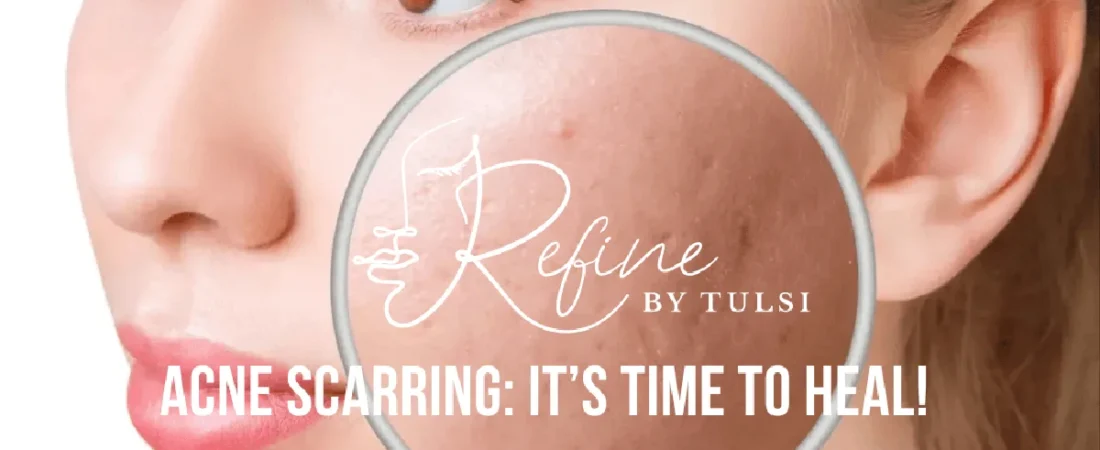
Most people with acne scarring try one treatment and wonder why it did not work. Here is the thing: acne scars are not a single problem. They are five different problems wearing the same name.
When a breakout goes deep enough to damage the tissue underneath, the skin heals in one of several ways. It can lose collagen and leave an indentation. It can overproduce collagen and create a raised scar. Or it can leave colour behind without changing texture at all.
The short answer: identifying which type you have determines what will actually help you. A surface laser that smooths texture beautifully does almost nothing for a scar anchored to the tissue below it.
Below is how each type presents and what addresses it best.
1. Ice-pick scars
Narrow, deep, V-shaped punctures extending well into the dermis. They look like small sharp holes — often less than 2mm across — and they are the most stubborn to treat because their depth exceeds what most surface treatments can reach.
What works: CO2 laser resurfacing, fractional depth work, or punch excision for very deep cases.CO2 laser resurfacing
2. Boxcar scars
Broad depressions with sharp, defined vertical edges — shallow craters most common on the cheeks and temples. The defined edge is what makes them visible: light catches the rim.
What works: CO2 laser resurfacing and RF microneedling, which soften those sharp edges and stimulate collagen to raise the floor of the scar.
3. Rolling scars
Wide, shallow, wave-like depressions that give the skin an undulating appearance. Here is what makes them tricky: rolling scars are caused by fibrous bands tethering the skin downward to the tissue beneath. The surface itself may look relatively normal.
You can resurface a rolling scar perfectly and it will still look depressed, because the problem is not on top — it is an anchor pulling it down from below.
What works: Subcisionsubcision to release those bands, followed by PRF or Sculptra to prevent re-adhesion. No laser or microneedling option substitutes for this step.
4. Hypertrophic and keloid scars
Raised, firm scars caused by collagen overproduction during healing. More common on the chest, back, and jawline than on the face. Keloids extend beyond the original wound boundary; hypertrophic scars stay within it.
What works: Steroid injection, laser therapy, and a professional assessment first. These respond to entirely different treatments than atrophic (indented) scars, and aggressive resurfacing can actually make them worse.
5. Post-inflammatory pigmentation and erythema
These are not true scars. The skin’s texture is intact — what remains is colour only.
Post-inflammatory hyperpigmentation (PIH)
Flat brown or dark marks left after a breakout, more common and more persistent in deeper skin tones. Best addressed by laser treatments selected for your skin tone and chemical peels.
Post-inflammatory erythema (PIE)
Pink or red flat marks caused by residual vascular dilation, more common in lighter skin tones. Best addressed by vascular-targeting laser therapy.
A note on deeper skin tones: aggressive lasers carry a genuine risk of worsening pigmentation in deeper Fitzpatrick types. Device selection, conservative settings, and pre-treatment preparation are not optional refinements — they are the difference between improvement and harm.
What to do next
Here’s what I tell my clients: most people have a combination. Boxcar scars on the temples, rolling scars on the cheeks, lingering pigmentation from earlier breakouts. A good plan sequences treatments rather than stacking them all at once.
And one honest expectation: scarring is improved, not erased. Substantial smoothing and evenness are realistic. Perfection is not — and anyone promising it is selling something.
The Science, Simplified: Acne scars fall into five categories based on what the skin did while healing — lost collagen, overproduced collagen, got tethered down, or just kept colour. The treatment that fixes one type may do nothing for another. Identify first, treat second. Combination therapy consistently outperforms any single approach.
Frequently asked questions
How do I know what type of acne scar I have?
Examine your skin under angled light rather than straight-on illumination — shadows reveal depth and edges that flat light hides. Ice-pick scars look like small sharp holes, boxcar scars have defined vertical edges, and rolling scars create a wave-like undulation.
Which acne scar type is hardest to treat?
Ice-pick scars are generally the most stubborn because their depth exceeds what most surface treatments reach. Very deep ones may need punch excision rather than resurfacing.
Can acne scars be completely removed?
No. They are meaningfully improved, not erased. Most people see substantial smoothing and evening of texture with a well-sequenced plan.
Are dark marks after acne actually scars?
Usually not. Post-inflammatory hyperpigmentation and erythema are colour changes — the skin’s surface is intact. They respond to different treatments than true atrophic scars, and many fade over time with sun protection alone.
Should I treat active acne before treating scars?
Yes. Treating scars while breakouts are ongoing creates new scarring and complicates healing. Active acne should be well controlled first.
If you feel sharp pain or something is off during recovery, see a qualified professional before continuing.


Leave a Reply