You know the moment. Your dentist frowns at the x-ray, taps a pocket depth of 6 mm, and says the words “advanced gum disease.” The standard next step has been the same for decades: scale the teeth, then add a course of antibiotics on top, because those deep pockets hold bacteria that the scaler can’t fully reach. It’s effective. It’s also, for a lot of people, the part where they start asking whether there’s something else.
There might be. A randomized, placebo-controlled trial published in the Journal of Periodontology in May 2026 tested a daily combination of omega-3 and low-dose aspirin against antibiotics in 109 adults with severe periodontitis — and the omega-3-plus-aspirin group finished almost exactly where the antibiotic group did: 57.7% versus 58.6% reaching the treatment goal after one year. Both crushed the scaling-only group at 23.1%.
The short answer, before we get into the details: if you have advanced gum disease, this is a promising early signal that a non-antibiotic adjunct may be coming — not a proven swap for antibiotics yet. The trial wasn’t powered to formally prove equivalence, only to show each active treatment beat placebo. But the closeness of those numbers is hard to ignore, and the implications for antibiotic resistance are real.
Disclaimer: This article summarizes a published clinical trial for informational purposes and is not medical advice. Omega-3 supplements and aspirin can interact with other medications and carry their own risks, including bleeding. Do not start, stop, or change any gum disease treatment, or begin a daily aspirin regimen, without talking to your dentist, periodontist, or physician first.
What Severe Gum Disease Actually Does
Periodontitis starts when bacteria build up below the gumline and trigger chronic inflammation. In its advanced stages, that inflammation doesn’t stay contained. It eats away at the bone and connective tissue holding your teeth in place, creating deep pockets between tooth and gum that become long-term hiding spots for more bacteria.
Everyone in this trial had stage III or IV periodontitis, grade B or C, using the staging system dentists rely on to classify severity based on bone loss and disease progression. That’s the more advanced end of the disease, not early gum inflammation or mild gingivitis. If your dentist has ever told you about “deep pockets,” this is the conversation.
The stakes of getting those pockets under control are higher than they might sound. A separate review of nearly 13,000 patients in long-term periodontal care found that people who failed to reach the same clinical target used in this trial (four or fewer deep sites) had more than double the risk of eventually losing a tooth. That’s why the treatment endpoint matters: it’s not an arbitrary cutoff, it’s a marker for long-term tooth survival.
The standard first step is scaling — sometimes called subgingival instrumentation — where a dental professional physically removes the bacterial buildup from below the gumline. For milder cases, that’s often enough. For severe cases, the deep pockets act as reservoirs that scaling alone can’t fully reach, which is why antibiotics get added on top.
Why Omega-3 and Aspirin Might Help
Antibiotics work by killing or suppressing the bacteria driving the infection. Omega-3 fatty acids take a different route: a broader body of research suggests they support the body’s own inflammation-resolving and tissue-repair processes rather than blocking a single inflammatory pathway. Low-dose aspirin is thought to work alongside that same resolution process.
Here’s the practical part, and it matters: this trial tested omega-3 and aspirin only as a combined regimen, not separately. So it can’t tell us how much of the benefit came from the omega-3, how much from the aspirin, or whether either would work well on its own. If future research splits them apart, the picture could change.
How the Study Was Designed
The trial (registered in Brazil’s clinical trials platform under ID RBR-7nh566t — think of it as the study’s official registration number, the way clinical trials get IDs in the US and Europe) was funded by the São Paulo Research Foundation (FAPESP) and CAPES. It ran out of the Albert Einstein Israelite Hospital of São Paulo, Guarulhos University, the University of Taubaté, and the University of São Paulo’s Ribeirão Preto dental school, with the senior author based at the Harvard School of Dental Medicine.
Recruitment ran from February 2022 to February 2024. One hundred nine adults with severe periodontitis — average age 48, about 60% women — completed the study and were split into four groups of 26 to 29 people each. Everyone received scaling first. From there:
- Placebo group (26 patients): dummy capsules made to look identical to the active treatments.
- Antibiotics group (29 patients): metronidazole (400 mg) plus amoxicillin (500 mg), three times daily for 14 days.
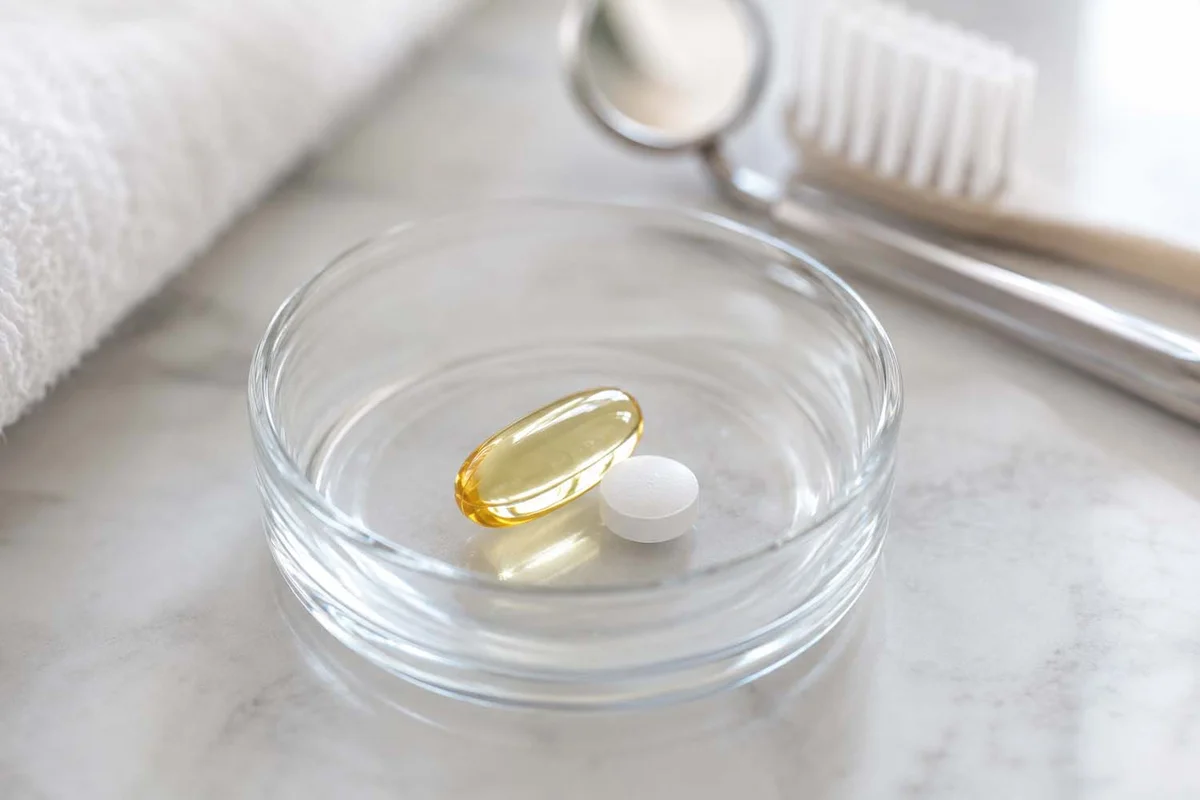
- Omega-3 and aspirin group (26 patients): 3 grams of omega-3 daily plus 100 mg of aspirin daily, both continued for six months.
- Combined group (28 patients): the 14-day antibiotic course alongside the six-month omega-3 and aspirin regimen.
Patients were checked at three, six, and twelve months. The researchers set a clear clinical target in advance: ending up with no more than four remaining periodontal pockets at least 5 mm deep. People with diabetes, active smokers, pregnant or breastfeeding patients, and anyone allergic to metronidazole, amoxicillin, aspirin, or fish and seafood were excluded before the trial began. So the results describe a systemically healthy, non-allergic population specifically — and that’s a limitation I’ll come back to.
The Results
By the one-year mark, 58.6% of the antibiotic group had reached the treatment target. The omega-3 and aspirin group came in at 57.7%, and the combined group at 57.1%. Scaling with a placebo only got 23.1% of patients there.
Put another way: for roughly every three patients treated with either antibiotics or omega-3-plus-aspirin instead of scaling alone, one extra patient reached the treatment goal who otherwise wouldn’t have. That’s a number needed to treat of just 3, which is genuinely strong for a chronic disease trial.
The bigger surprise was the combined group. Stacking antibiotics on top of omega-3 and aspirin didn’t produce a meaningfully better result than either treatment used by itself. The researchers had expected the combination to perform best going in. Their leading explanation is a ceiling effect: antibiotics and omega-3/aspirin work through different routes — killing bacteria versus resolving inflammation — but both are ultimately aimed at restoring a stable, healthy pocket depth. Once one pathway has done that job, there may be little room left for the other to add more.
The Stability Finding
One detail stood out to me, and I want to flag it with a caveat. The omega-3 and aspirin regimen ran for six months, and the one-year checkup fell exactly six months after patients stopped taking it. Their results held essentially flat between the 6-month and 12-month checkups — 57.7% at both points — while the antibiotic group’s success rate kept climbing during that same window, from about 52% at six months to 58.6% at one year.
That stability after stopping the supplement regimen is worth noting. But because the two therapies were measured on different timelines relative to when treatment ended, it’s not yet clear how much of that pattern reflects a genuinely longer-lasting effect versus simply different follow-up windows. The researchers are careful about this, and so should we.
What Predicted Who Responded Best
In an additional analysis, the researchers looked at what actually predicted whether a patient hit the treatment goal, beyond which group they were in. Two factors stood out: how well-controlled a patient’s plaque was, and how deep their pockets were to begin with.
Patients on any of the three adjunctive therapies were about 3.5 times more likely to reach the goal than those on placebo, but plaque control had the single strongest statistical link to success in the whole analysis. Here’s what I tell my clients: the supplement stack doesn’t replace the fundamentals. Daily brushing and flossing habits remain a major part of how any of these treatments play out, in the mouth and in the gym. The adjunct helps; the baseline drives.
Was It Safe?
Patients in every group filled out a symptom questionnaire at multiple points during the study, covering things like nausea, headaches, diarrhea, and mood changes. No significant differences turned up between any of the groups, and no one in the trial experienced a serious adverse event requiring medical treatment or hospitalization.
The one mild pattern the researchers noticed, without it reaching statistical significance, was that slightly more people in the omega-3 group reported a fish or seafood-like aftertaste. If you’ve ever taken high-dose fish oil, you know this one. It’s common, it’s harmless, and it’s the least of your problems if your pockets are at 7 mm.
Why This Matters Beyond Your Gums
Antibiotic resistance is one of the most pressing problems in modern medicine. Every unnecessary course of antibiotics adds to the pressure that helps resistant bacteria spread. That’s part of why researchers are interested in options that reduce reliance on them without sacrificing results — and this trial is exactly the kind of data point that matters for that conversation.
It’s also worth being precise about the allergy angle, since it’s easy to overstate. This trial specifically excluded anyone with a known allergy to metronidazole, amoxicillin, aspirin, or fish and seafood — so it did not test omega-3 and aspirin in the population that might benefit most from an antibiotic-free option. What the trial does show is that omega-3 and aspirin work about as well as antibiotics in patients who could have safely taken either. That’s a reasonable, but still unproven, basis for future research specifically in antibiotic-allergic patients.
Omega-3’s inflammation-related research extends well beyond the mouth, particularly into cardiovascular health. The same fatty acids that may help your gum pockets are the same ones studied for artery function and blood pressure. Whether this trial changes how we think about omega-3 more broadly is a story for a separate day, but the connection is real.
The Catches: What This Study Doesn’t Prove Yet
This is one trial, and the researchers are careful to frame it as encouraging rather than conclusive. A few limitations are worth keeping in mind:
- Sample size. The trial was originally designed to enroll 200 patients for full statistical power. Pandemic-era disruptions and budget constraints in Brazil limited enrollment to 109, giving the study roughly 75% power instead of the planned 80%. The authors say this is still enough to support their main conclusions, but it’s a real limitation worth knowing about.
- No head-to-head comparison. The study was not statistically powered to directly compare the three active therapies against each other, only each against placebo. The close percentages (57 to 59%) are a strong signal, not formal proof of equivalence.
- Healthy population only. Participants did not have diabetes, were non-smokers, and had no other major systemic disease. It’s unclear how the results would hold up in people with more complex health backgrounds.
- Different treatment timelines. The omega-3 and aspirin regimen lasted six months and the antibiotic course lasted 14 days, so the one-year follow-up point falls at different distances from the end of treatment for each group. That complicates any direct claim about which therapy’s benefits last longer.
- Mechanism still being worked out. Follow-up microbiological work is ongoing to confirm exactly how each treatment changes bacteria levels in the gum pockets.
- Scaling wasn’t optional. Nobody in this study skipped professional scaling. Omega-3 and aspirin were tested as an addition to standard care, not a substitute for it.
None of this changes the most reliable lever anyone has against gum disease: catching it before it reaches stage III or IV. If routine dental visits or daily oral care have slipped, that’s the first thing to fix before you start thinking about supplements.
Frequently Asked Questions
Should I start taking fish oil and aspirin instead of antibiotics for gum disease?
No, not on your own. This was one trial of 109 people, it wasn’t powered to prove the two therapies are formally equivalent, and it tested a specific clinical-grade dose alongside professional scaling, not a self-directed supplement routine. Talk to your dentist or periodontist before changing how you treat existing gum disease.
What dose of omega-3 and aspirin did the study use?
Participants took 3 grams of omega-3 per day plus 100 mg of aspirin per day, both for six months. That omega-3 dose is notably higher than a typical over-the-counter fish oil serving, and the aspirin dose matches standard low-dose, or baby, aspirin tablets. The two were only tested together, not separately.
Is aspirin safe to take daily for six months?
Daily aspirin carries its own risks, including bleeding and stomach irritation, and isn’t appropriate for everyone. In this trial, no serious adverse events occurred in any group over the full year, but participants with a history of gastritis, gastric ulcers, or blood disorders were screened out before enrollment. This is a decision to make with a physician, not a general recommendation.
Why didn’t combining antibiotics with omega-3 and aspirin work better?
The researchers were surprised by this too. Their leading explanation is a ceiling effect: antibiotics and omega-3/aspirin control the disease through different mechanisms, but both converge on the same clinical outcome. Once one pathway has adequately restored pocket depth, there may be limited additional room for the other to improve on it.
Does this study apply to people with diabetes or people who smoke?
Not directly. People with diabetes, active smokers, and anyone with another major systemic condition were excluded from the trial specifically because those factors can change how the body responds to periodontal treatment. The results describe an otherwise healthy population, and the authors note that outcomes could differ in people with more complex health backgrounds.
Was this study large enough to be conclusive?
It’s meaningful but not the final word. The trial was originally designed for 200 participants and enrolled 109 due to pandemic-related and budget constraints, landing at about 75% statistical power instead of the planned 80%. The authors describe the findings as a foundation for larger, more targeted trials rather than a conclusive answer.
Who might benefit most from this approach if future research confirms it?
Researchers point to patients who can’t take antibiotics — for reasons like allergy or a preference to limit antibiotic use for resistance concerns — as the most logical group to study next. It’s worth repeating that this specific trial excluded allergic patients, so that benefit is a plausible next research direction rather than something this study directly proved.
Does scaling alone do anything for severe gum disease?
Yes, but on its own it was the weakest option in this study. Only 23.1% of the placebo-plus-scaling group reached the treatment goal after a year, compared with roughly 57 to 59% in the antibiotic, omega-3-plus-aspirin, and combined groups.
The Science, Simplified
In a year-long trial of 109 adults with severe gum disease, taking 3 grams of omega-3 plus 100 mg of aspirin daily for six months got 57.7% of people to the treatment goal at one year — almost exactly the same as the antibiotic group at 58.6%, and far ahead of the 23.1% who just had their teeth scaled. Adding antibiotics on top of the omega-3-aspirin combo didn’t help, probably because both approaches cap out at the same endpoint: healthy pocket depth. The catch: it’s one trial, underpowered to prove the two are truly equivalent, and it only tested otherwise healthy non-smokers. For now, it’s a promising sign that a non-antibiotic option may be coming — but your dentist still makes the call. And no matter which treatment you get, the plaque control you do at home is the strongest single predictor of whether it works.
Sources
- Castro dos Santos, N.C., de Brito Silva, R.N., Colombo, F.S., et al. “Immunomodulators, associated or not with systemic antibiotics, to treat periodontitis: A 1-year multicenter, placebo-controlled, double-blind, randomized clinical trial.” Journal of Periodontology, 2026; 97(7): 1454.
- Ribeiro, A.P.F., de Lima Rodrigues, M., Loureiro, C., et al. “Physical exercise alone or combined with omega-3 modulates apical periodontitis induced in rats.” Scientific Reports, 2025; 15: 8760.


Leave a Reply