
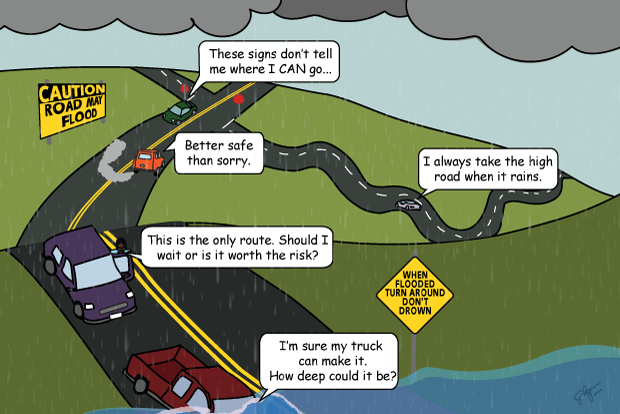
Driving in heavy rain is already a challenge, but flash floods add an entirely new layer of danger. When streets suddenly transform into waterways, motorists face split-second decisions: should they attempt to drive through the water or find a safer route? Recent research funded by the National Oceanic and Atmospheric Administration (NOAA) sheds light on how drivers make these high-stakes choices and how improved information could make a life-or-death difference.
The study, led by a team supported through NOAA’s Climate Program Office Regional Integrated Sciences and Assessments (RISA) program, examined the cultural and situational factors that influence drivers confronted with flooded roadways. The research focused on Tucson, Arizona, a city whose streets routinely flood during the monsoon months of July and August. Tucson also runs a program called “Operation Splash,” which uses permanent signs, temporary A-frame messages, and physical road barriers to discourage drivers from entering dangerous floodwaters. By exploring driver psychology in this context, the team sought to determine what types of messaging most effectively encourage safe behavior.
Researchers collected data through two focus-group interviews with Tucson flood-risk managers and a mail-in survey sent to city residents. Residents were asked to reflect on their past experiences with flooded streets as well as their likely choices in hypothetical scenarios. The findings highlight a nuanced decision-making process: drivers weigh multiple factors before deciding whether to attempt a crossing.
When it comes to deterrents, Tucson drivers identified three main considerations. First, the most significant factor was safety: the risk of injury or even death. Second, official warnings—such as road signs or barricades—had a strong influence. Third, the potential damage to their vehicle played a role in discouraging risky crossings. On the other hand, the survey revealed what motivates drivers to push through floodwaters. Leading incentives included seeing another car successfully make it across, having family members waiting on the other side, and a lack of knowledge about alternative routes.
Trust also emerged as a central theme. Drivers indicated that certain sources of information carry more weight than others. Firefighters topped the list as the most trusted authority, followed by environmental cues like observing other vehicles navigating floodwaters, and then emergency responders. This hierarchy suggests that both official messaging and real-world cues are critical in shaping driver behavior.
One of the study’s key goals was to evaluate the effectiveness of public information campaigns. The results were encouraging: signs, barricades, and city messaging are indeed trusted by drivers. However, the presence of water alone doesn’t automatically signal danger to motorists. Drivers actively seek more detailed information, such as real-time indicators of water depth, flow, and obstacles, before deciding whether to proceed. Observing another vehicle successfully cross, for example, often reassures drivers who are unsure about the risk.
The research suggests that municipalities could improve road safety by offering more specific, actionable information during flood events. Instead of generic warnings like “Road May Flood,” officials could provide details on the severity of the flooding, current road conditions, and recommended detours. Combining these messages with trusted authorities on the scene—firefighters or emergency responders—could further enhance compliance and reduce risky behavior.
This work aligns closely with the broader goals of the RISA program, which emphasizes process, partnership, and trust-building in preparing communities for climate variability and change. By studying driver behavior and the effectiveness of messaging during flood events, NOAA aims to expand the nation’s capacity to adapt to increasingly extreme weather conditions. Tucson’s experience provides a compelling case study for other cities grappling with similar hazards: when drivers are armed with better, more reliable information, they are far more likely to make decisions that keep themselves—and others—safe.
In a world where flash floods are becoming more frequent and unpredictable, understanding human behavior is as important as understanding hydrology. This research demonstrates that the combination of clear, credible information and situational awareness can prevent tragedy. As monsoon storms continue to sweep through cities like Tucson, empowering drivers with timely and trustworthy data may well save lives—and vehicles—one flood at a time.