
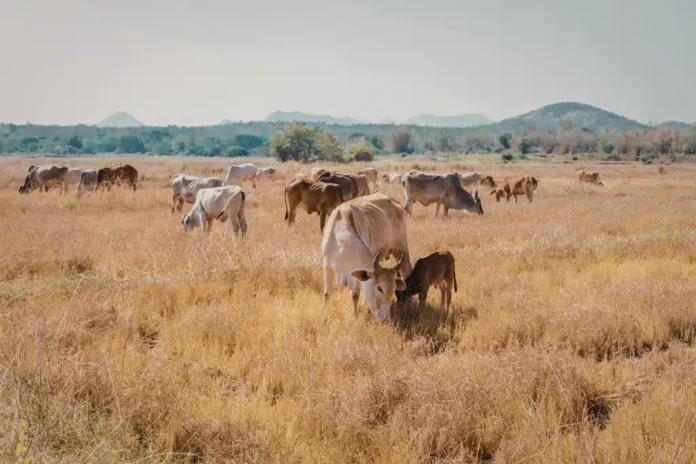
Grasslands, which serve as the backbone for over a billion grazing animals worldwide, could shrink by up to half by the end of the century as climate change intensifies, according to a new study. The findings raise serious concerns for global food security, particularly in low-income countries already grappling with hunger, economic instability, and fragile political systems.
The analysis, conducted by the Potsdam Institute for Climate Impact Research (PIK), highlights the particularly acute risks facing Africa. African grasslands, which already exist at the upper limits of their climatic tolerance, may face contraction rates of just 16% if global greenhouse gas emissions are drastically reduced. However, under a “business as usual” scenario where emissions continue to rise unchecked, the losses could soar to 65%.
“Climate change will shift and significantly reduce grazing areas worldwide, leaving fewer spaces for animals to thrive,” said Chaohui Li, the study’s lead author. “Much of this impact will fall on countries already struggling with hunger, economic and political instability, and heightened gender inequality.”
The Double Burden of Livestock
Livestock farming is caught in a paradox: it both suffers from climate change and contributes to it. According to the UN Food and Agricultural Organization, meat and dairy production accounts for roughly 14.5% of global greenhouse gas emissions. In addition, the EAT-Lancet Report of 2025 identified food systems as the leading driver of planetary boundary breaches, contributing to five out of six critical environmental thresholds.
The PIK study uses the concept of a “safe climatic space” to determine where grasslands can sustainably exist. This framework identifies optimal conditions for grazing as temperatures between -3°C and 29°C, rainfall from 50 to 2,627 millimeters annually, humidity between 39% and 67%, and wind speeds of 1 to 6 meters per second. When these thresholds are exceeded, grasslands become unsuitable for livestock.
A Global Decline With Local Consequences
Researchers project a global net decline of 36 to 50% in areas suitable for grazing by 2100. The consequences will not be evenly distributed: 51% to 81% of affected populations reside in low-income countries, where hunger, gender inequality, and political fragility are already pressing concerns. The study warns that these shifts could trigger widespread socioeconomic consequences, destabilizing food production systems and the communities that rely on them.
Some regions may see grazing suitability shift southward—for example, from the Ethiopian Highlands and East African Rift Valley toward new areas. However, for many coastal regions, no new land exists to accommodate migrating herds. “The magnitude of these changes exceeds what traditional adaptation strategies—like switching livestock species or moving herds—can manage,” said Prajal Pradhan, assistant professor at the University of Groningen and co-author of the study.
Unequal Impacts and the Risk of Instability
The findings underscore a stark truth: climate change does not act evenly. Communities already facing social, economic, and political challenges are likely to bear the brunt of environmental shifts. Reduced grazing land threatens livelihoods, exacerbates food insecurity, and could deepen existing inequalities.
In practical terms, the decline in grasslands affects not just individual farmers, but the global livestock industry. Cows, sheep, and goats are integral to millions of livelihoods and a significant source of food worldwide. Shrinking pastures could drive up meat and dairy prices, strain food distribution systems, and intensify competition for remaining arable land.
Moving Forward
The study makes clear that urgent action is needed. Reducing greenhouse gas emissions globally remains critical to limiting grassland losses. Beyond mitigation, strategies to enhance the resilience of affected communities—such as sustainable grazing management, diversified livelihoods, and support for vulnerable populations—will be crucial.
“Future climate change will challenge the very spaces that allow animals to graze,” Li noted. “Addressing this threat is not just about protecting ecosystems—it’s about safeguarding people, economies, and the global food system.”
As the climate crisis continues to unfold, grasslands stand as both a symbol and a barometer of vulnerability. Protecting them is essential for ensuring that the billions of people and animals depending on them today can continue to thrive tomorrow.