
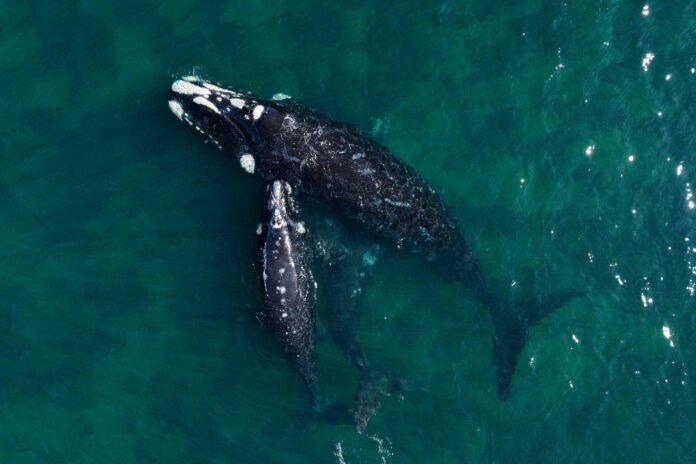
For decades, southern right whales symbolized hope in the fight to protect marine life. Once hunted nearly to extinction in the 19th century, these massive baleen whales staged a slow but remarkable recovery after commercial whaling was banned in the 1980s. Now, new research indicates that climate change is threatening to undo that progress.
“In my lifetime, the right whale was believed to be extinct,” says Robert Brownell Jr., a biologist at the National Oceanic and Atmospheric Administration’s Southwest Fisheries Science Center. “Their protection and resurgence along Southern Hemisphere coasts once offered a success story for conservation. Today, their future is uncertain.”
A study published this month in Scientific Reports, co-authored by Brownell and colleagues in Australia and South Africa, shows that southern right whales are reproducing less frequently than they have historically. Where females once calved every three years, new evidence suggests that the interval has now extended to roughly every four years—a trend researchers trace to climate-driven changes in the Antarctic ecosystem.
The Link Between Climate and Reproduction
Southern right whales feed primarily on Antarctic krill, tiny shrimp-like crustaceans that form the foundation of the Southern Ocean’s food web. Every year, whales spend several months—from January through June—in Antarctic and sub-Antarctic waters, consuming up to 800 pounds of krill daily. This massive intake allows them to build energy reserves necessary for the months-long migration to warmer breeding grounds in Australia, South Africa, or Argentina, where they nurse their calves.
“These whales rely on the fat they accumulate during feeding to sustain pregnancies and care for their calves,” explains Matthew Germishuizen, a postdoctoral researcher at the University of Pretoria’s Mammal Research Institute.
But rising ocean temperatures and shrinking sea ice are disrupting these feeding grounds. Krill depend on sea ice for shelter and nourishment, particularly as juveniles, and recent years have seen Antarctic ice coverage reach historic lows. With their habitat melting, krill are moving farther south or disappearing from some areas entirely. This forces whales to expend more energy to locate sufficient food, ultimately affecting their health and reproductive success.
“Their prey is shifting, which means the whales must work harder to eat,” notes Claire Charlton, a lead author of the study and associate researcher at Flinders University in South Australia. “When feeding conditions decline, the time between calves increases.”
Germishuizen emphasizes that the timing of this reproductive slowdown aligns closely with major environmental changes, including sea ice loss, ocean warming, and broader climate variability in the Southern Ocean.
Decades of Observation Reveal the Decline
The findings are based on more than 30 years of data collected by Australian Right Whale Research, a monitoring program led by Charlton. Researchers track whales each year, primarily from May to October, when the animals migrate to the Great Australian Bight—a critical breeding and calving area stretching over 700 miles along Australia’s southern coast.
Photo identification is the cornerstone of the research. Southern right whales have unique white and gray patches of thickened skin, called callosities, on their heads. Much like human fingerprints, these patterns allow scientists to identify individual whales and track them over time. Through this method, Charlton and her team have cataloged over 3,000 whales, recording calving intervals and migration histories.
The data make clear that the reduction in birth rates is not a temporary anomaly but a persistent, climate-driven shift—a warning signal for both southern right whales and the larger marine ecosystem. Previous studies have documented similar trends among other Antarctic-feeding whales, including humpbacks. “Years with lower sea ice often lead to lower pregnancy rates the following year because prey is scarcer,” explains Ari Friedlaender, an ecologist at the University of California, Santa Cruz.
Human Activity Adds Pressure
Climate change is not the only threat. Noise pollution, vessel strikes, and entanglement in fishing gear also jeopardize whale populations as they travel between feeding and breeding grounds. Moreover, commercial krill fishing has reached record levels; in 2025, vessels harvested nearly 620,000 tons of krill in the Southern Ocean. Although this represents a fraction of the total krill population, most catches are concentrated near the Antarctic Peninsula, a vital feeding area for multiple baleen whale species. This localized extraction intensifies competition for food already stressed by climate impacts.
Conservation and Policy Responses
Researchers stress that immediate action is needed to protect these whales. Expanding marine protected areas in both feeding and breeding habitats could reduce human disturbance and safeguard critical resources. The High Seas Treaty, which took effect in January, offers a framework to establish protections in international waters, mitigating the impact of increasing shipping traffic.
Ultimately, experts agree that long-term recovery will depend on addressing the root cause of the problem: climate change. “We must significantly reduce greenhouse gas emissions to reverse ocean warming and ice loss,” Charlton says. “Without tackling this, even the most robust protections may not be enough to save southern right whales.”
The southern right whale’s story is one of resilience tested by a changing world. Their recovery from near-extinction demonstrates what conservation efforts can achieve—but climate change now threatens to erase decades of progress, underscoring the urgency of global action to preserve both the species and the delicate ecosystems they depend on.