
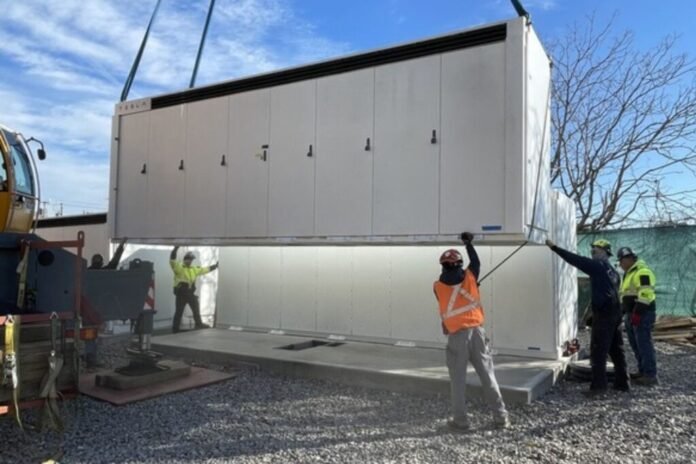
In a year defined by rapid change across the U.S. energy landscape, one technology surged ahead of expectations: battery storage.
According to new data released by the Solar Energy Industries Association (SEIA), the United States added a record 57.6 gigawatt-hours (GWh) of new energy storage capacity in 2025—the largest single-year expansion ever recorded. The milestone signals more than just industry momentum; it marks a structural shift in how America generates, stores, and delivers electricity.
A Breakthrough Year for Storage
The 2025 installation total represents a 30% increase over the previous record set in 2024. Even more striking, today’s deployment levels are roughly four times what the industry achieved just three years ago. If projections hold, cumulative installations could exceed 600 GWh by 2030.
Those figures underscore a clear reality: energy storage is no longer an emerging technology waiting in the wings. It is becoming a central pillar of the modern grid.
The findings come from the U.S. Energy Storage Market Outlook (ESMO) Q1 2026 report, produced jointly by SEIA and Benchmark Mineral Intelligence. As of the end of 2025, the U.S. had installed:
- 137 GWh of utility-scale storage
- 19 GWh of commercial and industrial (C&I) storage
- 9 GWh of residential storage
Utility-scale systems—large battery installations connected directly to the grid—continue to dominate total capacity. But strong growth in residential and commercial segments suggests storage adoption is broadening across the economy.
Red States, Blue States—and a Surprising Map
One of the more noteworthy developments is where much of this growth occurred.
Two-thirds of all utility-scale storage installed in 2025 was built in states carried by President Donald Trump. In fact, nine of the top 15 states for new installations fall into that category. This geographic spread highlights how energy storage has transcended partisan lines, driven more by economics and grid reliability needs than political identity.
Texas stands out in particular. Long known for its independent grid and rapid energy development, the state is projected to surpass California in 2026 as the nation’s largest energy storage market. That would represent a symbolic shift, as California has historically led in renewable energy deployment and battery installations.
Why Storage Is Expanding So Quickly
Several forces are converging to accelerate storage growth.
First, electricity demand is rising again after years of stagnation. The expansion of data centers, AI computing infrastructure, and industrial electrification is placing new pressure on the grid. Storage helps utilities meet peak demand without building expensive new fossil-fuel “peaker” plants.
Second, battery systems are increasingly being deployed in two primary configurations:
- Standalone storage, which added nearly 30 GWh in 2025
- Solar-plus-storage, which contributed about 20 GWh
Standalone batteries provide flexible grid services, such as frequency regulation and peak shaving. When paired with solar, storage captures excess midday generation and releases it during evening hours when demand spikes—improving both economics and reliability.
Residential systems are also growing rapidly. Home battery installations reached 3.1 GWh in 2025, marking a 51% increase year over year. Much of that growth is tied to expanding virtual power plant (VPP) programs in states like Massachusetts, Texas, Arizona, and Illinois. VPPs aggregate thousands of distributed home batteries, allowing grid operators to dispatch them collectively during peak demand events.
For homeowners, the appeal is clear: backup power during outages, potential bill savings, and participation in grid support programs that offer financial incentives.
Manufacturing Shifts: From EVs to Stationary Storage
Another important development unfolded behind the scenes in 2025: battery manufacturers adjusted their production strategies.
As electric vehicle demand experienced shifts in certain markets, some manufacturers redirected capacity toward stationary storage production. Existing lithium-ion battery lines were retooled, and future plans were modified to prioritize grid-scale applications.
According to SEIA’s Solar and Storage Supply Chain Dashboard, lithium-ion battery cell manufacturing for stationary applications climbed to more than 21 GWh in 2025. This shift signals confidence in long-term storage demand and strengthens domestic supply chains.
While lithium-ion remains dominant, the ESMO report also tracks emerging chemistries such as sodium-ion, zinc-based batteries, metal-air systems, and flow batteries. These technologies could offer advantages in cost, safety, or long-duration storage in the coming decade.
A Policy Crossroads
Despite the record-setting year, industry leaders caution that continued growth is not guaranteed.
Federal actions targeting clean energy incentives could affect investment decisions and deployment pace. Storage benefits from tax credits and supportive policy frameworks, and uncertainty can slow project financing.
Industry executives argue that scaling back support risks higher electricity prices and reduced grid resilience. Storage reduces price volatility by shifting electricity supply across time and stabilizes grids during extreme weather events or unexpected outages. In regions prone to storms, wildfires, or heatwaves, battery systems increasingly serve as critical infrastructure.
The Bigger Picture: A Grid in Transition
The rapid expansion of energy storage reflects a broader transformation of the U.S. power system.
Renewable generation—especially solar—continues to grow, but solar output peaks during midday. Storage solves the mismatch between when renewable energy is produced and when it is most needed. In doing so, it enhances reliability without sacrificing environmental gains.
As electricity demand climbs and extreme weather events intensify, flexibility becomes essential. Storage provides that flexibility. It absorbs excess generation when supply is abundant and discharges power when demand surges.
The record 57.6 GWh installed in 2025 is more than a statistic—it’s evidence that storage has moved from niche technology to grid backbone. With projections pointing toward more than 600 GWh installed by 2030, the trajectory suggests sustained expansion.
The coming years will test whether policy, manufacturing, and market demand remain aligned. If they do, energy storage may not only support America’s energy transition—it may define it.