
You did the work. You figured out what you actually want. Maybe you even wrote it down, felt that rush of excitement, told yourself this time would be different.
And then life happened.
The emails piled up. The kid needed something. There was a crisis at work. And before you knew it, your goals were back on the “later” list — right where they always end up.
Here is the truth nobody tells you after all that clarity work: knowing what you want is not enough. Your current life is perfectly designed to give you your current results. And if you want different results, you have to change the way you actually operate — not just the way you think.
Clarity Is Not Enough
The question that always follows “what do you want?” is this: what are you willing to change to get it?
Clarity alone does not create transformation. It just shows you the gap between where you are and where you want to be. And if you want to close that gap, you have to change something real.
Why You Wake Up Already Behind
You can have all the clarity in the world about what you want, but if you do not change how you plan, prioritize, and spend your time — nothing will be different six months from now.
I am not talking about surface-level fixes like “wake up earlier” or “track your macros.” I mean fundamental shifts in how you operate each day.
Here is what typically happens after you set a real goal. For a few days, maybe a week or two, you are fired up. You hit the gym with purpose. Your meals are dialed in. Everything feels different.
And then life happens.
A work deadline looms. The dog is sick. There is laundry, emails, and someone needs you to run something by the store. Before you know it, you are right back in the same patterns that were keeping you stuck in the first place.
You tell yourself you will get back on track later. After this week. After things calm down.
But they never calm down. There is always one more thing.
The Real Reason You Do Not Follow Through
It is not because you are lazy. It is not a willpower problem or a discipline deficit, and it is certainly not because your goals are not worth pursuing.
It is because your current life is organized around maintaining the life you already have — not creating the one you want.
Every habit, every routine, every way you spend your time is designed to keep the status quo running smoothly. You are trying to build a new future using old patterns. And it does not work.
The First Hour Test
When you wake up in the morning, what is the first thing you do?
I do not need to ask my clients — I already know the answer for most of them. Either they grab their phone and start scrolling, or they immediately start thinking about everything on today’s list.
They respond to texts. They answer emails. They put out fires. They take care of everyone else’s needs first.
In eight years of coaching, the number one mistake I see is people starting their day in reactive mode. You are not being irresponsible — you are just trying to keep all the plates spinning. But what is actually happening is that every single day, you are prioritizing other people’s urgency over your own future.
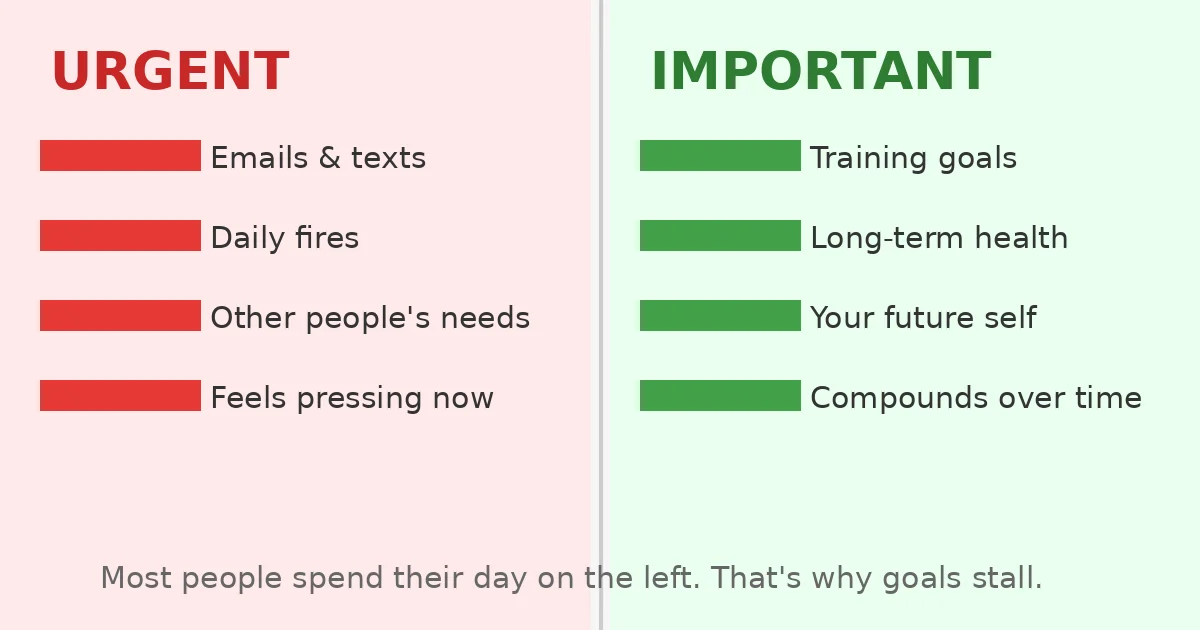
Right now, the laundry feels urgent. The email feels urgent. The deadline feels urgent. Your goals? Those never feel urgent. So they always get pushed to later.
And later never comes.
Urgent vs. Important: The Difference That Matters
This is the game-changer, and it is something I explain to every new client who tells me “I just do not have time to train consistently.”
Urgent tasks demand your attention right now. They have deadlines. They create stress if you ignore them: answering emails, paying bills, grocery shopping, dealing with a work emergency.
They are your daily fires. And they never go away — there will always be new ones.
Important tasks are different. They are the things that move you toward your goals. Future-focused. About who you are becoming, not just who you are today.
Maybe it is programming a new block of training. Maybe it is finally learning to squat with good form. Maybe it is meal prepping on Sunday so the week does not derail. These things might not seem pressing in the moment, but they compound.
Here is the problem: urgent tasks will always feel more pressing than important ones. Your goals do not have a hard deadline screaming at you. Nothing is on fire when it comes to your long-term progress, which makes them easy to ignore.
Unless you have a system that forces you to prioritize the important stuff first, it will always lose to the urgent. Every single time.
The System That Actually Works
Here is what I tell my clients: you do not find time for your goals — you protect it.
I use a framework that borrows from something called “Wildly Important Goals.” At the start of each quarter, you pick one goal. Just one. The thing that matters most for the next 90 days. Not five goals. One. Because when everything is important, nothing is.
Then you break it down: monthly priorities, weekly tasks, daily focus.
Every week, you categorize your tasks into three buckets:
- A-tasks: Things that move you closer to your goals. Important. Future-focused. These are non-negotiable.
- B-tasks: Things that should get done but do not directly move the needle. Necessary, not transformational. Errands, emails, appointments.
- C-tasks: Everything else. The nice-to-dos. The would-be-great-ifs.
And then — this is the part most people miss — you block out time for your A-tasks first. Before email. Before errands. Before anyone else’s needs.
If you start your day by checking your inbox, you will spend three hours in it. If you start by scrolling social media, an hour vanishes. But if you start by doing your most important task — your A-task — you will be amazed at what focused time can produce.
Most of the “urgent” stuff is not actually that urgent. That email can wait an hour. The laundry can wait until this afternoon. Your goals can not wait forever.
What Happens When You Start Prioritizing Differently
I have seen this play out repeatedly with my clients. Here are a few real examples:
Jennifer is a small business owner who had been avoiding her accounts receivable for months because it felt deeply uncomfortable. She made tackling it her A-task every week, ahead of all the “urgent” noise. In just 12 hours total this quarter, she found over $180,000 in outstanding invoices that were owed to her. She had been putting it off because it never felt urgent — even though it was the most important thing she could have done.
Sherry finally launched her podcast after thinking about it for a year and a half. Making it an A-task, not a “someday” goal, turned intention into action.
Stephanie set a quarterly goal to build consistent daily systems that would let her show up for both her business and her family during the holidays. Her weekly A-tasks were setting up those systems — things she had previously avoided because she told herself she was too busy.
Mona needed to organize all her inventory to revive her craft business, something she had been avoiding for a long time. Small weekly progress on it kept her on track to finish by quarter’s end.
None of these people suddenly found more hours in the day. None of them magically became more disciplined. They just started planning differently — and when you plan differently, you execute differently.
Your Brain Will Fight You On This
Even with a system, even when you know what to do, you will still hit resistance. Your brain likes the familiar. It likes old patterns, even when they are not serving you.
When you sit down to work on your A-task first thing in the morning, your brain will say things like:
- You should answer those emails first. What if someone needs something?
- This can wait until later. It is not that important.
- What if you are wasting your time? What if it does not work?
That is resistance. And it is completely normal. You just have to recognize it and push through anyway.
You Are Not Just Changing Habits — You Are Building Identity
This is the part people miss when they ask how to change their habits: it is not really about the habit. It is about the identity underneath it.
Every time you choose your A-task over someone else’s urgency, you are building evidence that you are the kind of person who follows through. Who keeps commitments to themselves. Who prioritizes what actually matters.
That shift does not happen overnight. It happens through daily decisions — even when it is hard, even when people do not understand — and it compounds quietly until one day you realize: I am the kind of person who does what they say they are going to do.
The Science, Simplified
When researchers studied why most goal-setting efforts fail, the pattern was consistent: people do not lack motivation or clarity. They lack a prioritization system that protects important tasks from urgent ones. The fix is not more willpower — it is a weekly planning rhythm that schedules your highest-impact work before anything else can crowd it out.
Your Next Step
Here is the direct part, and I will be honest with you: if you do not change how you plan and execute your week, you will be in roughly the same place a year from now. No matter how clear you feel right now.
Your current habits will not get you the life — or the physique, or the strength — that you want. They just will not.
I do not care how motivated you feel today. I do not care how good your intentions are. If you keep doing what you have always done, you will keep getting what you have always gotten.
But when you make this one shift — prioritizing the important ahead of the urgent — it changes everything. You start to believe in yourself again. You start to trust that you can follow through. And that belief is worth more than any system, any program, any piece of advice.
Frequently Asked Questions
What is the difference between urgent and important tasks?
Urgent tasks demand immediate attention and create stress if ignored — things like emails, bills, and daily fires. Important tasks move you toward your goals and the future version of yourself you are trying to become. The problem is that urgent tasks always feel more pressing, so without a system to prioritize important tasks first, your goals will always lose.
What is a Wildly Important Goal?
A Wildly Important Goal (WIG) is the single most important thing you could accomplish in the next 90 days — the one goal that, if achieved, would make everything else easier or less necessary. Pick just one per quarter, because when everything is important, nothing is.
Why do I never follow through on my goals?
Because your current life is perfectly designed to give you your current results. Every habit, routine, and pattern you have is organized around maintaining the life you already have — not creating the one you want. Following through requires changing how you plan and prioritize, not just getting clearer on what you want.
How do I stop living reactively?
Start by identifying where you spend your time reactively — responding to emails, managing other people’s needs, putting out fires. Then build a weekly planning rhythm that blocks time for your A-tasks before anything else. The shift from reactive to intentional does not happen overnight; it happens through daily decisions to choose your future over everyone else’s urgency.
The research will not make you strong by itself. The next workout will. Pick one thing from this article — block out time for your A-task before you check email tomorrow morning — and run it for six weeks. Then judge the results. That is the whole secret, and it always has been.