I get this question from clients at least once a week: "I’m training hard, eating what I think is healthy, but the scale won’t budge. Am I broken?"
You are not broken. You’re probably just not in a calorie deficit.
Here’s what that means, why it matters more than any supplement or workout trick, and exactly how to set one up so it actually works in real life — not just on paper.
The short answer
A calorie deficit happens when you eat fewer calories than your body burns over a sustained period. That’s the mechanism behind every pound of fat lost. No diet, no fasting window, no supplement bypasses this rule.
A 2019 nutrition review made it explicit: short-term strategies like high-protein low-carb diets or intermittent fasting can give you a head start, but long-term evidence shows that different diets produce similar weight loss. What actually predicts success is adherence to a diet that creates a negative energy balance and emphasizes food quality.
Weight loss is not the same as fat loss
This matters more than most people realize. You can lose weight by losing water, glycogen, or muscle tissue. Fat loss specifically requires two things:
- A calorie deficit
- Resistance training to signal your body to keep the muscle it has
If you cut calories without lifting weights, a meaningful chunk of what you lose will be lean tissue. If you lift without a deficit, you won’t lose fat. Both matter.
The problem with counting exercise calories
Here’s the thing most people underestimate: exercise burns far fewer calories than it feels like it does.
A study published in the journal Obesity Facts found that normal-weight men and women overestimate their exercise energy expenditure by 3 to 4 times. When asked to compensate for burned calories with food, they still ate 2 to 3 times more than what was actually expended.
Let me put this in numbers. An average cardio or weight training session of 45 to 60 minutes burns roughly 200 calories. Most people would guess 600 to 800 for the same workout. Your rate of perceived exertion is lying to you.
Just because a run feels brutal doesn’t mean it torches 1,000 calories. It almost certainly does not.

Why tracking food intake matters
The only reliable way to create a calorie deficit is by managing what goes in, not what you think you burned getting out of the way. And humans are notoriously bad at estimating both.
A study on self-reported caloric intake found that the reason many people fail to lose weight — despite reporting they eat very little — is simply that their actual intake is substantially higher than what they report, and they overestimate physical activity at the same time. Two errors compounding each other.
Here’s what I tell my clients: trust your scale more than you trust your memory.
The napkin math method
If calculators and apps overwhelm you, this rule of thumb works well for most people:
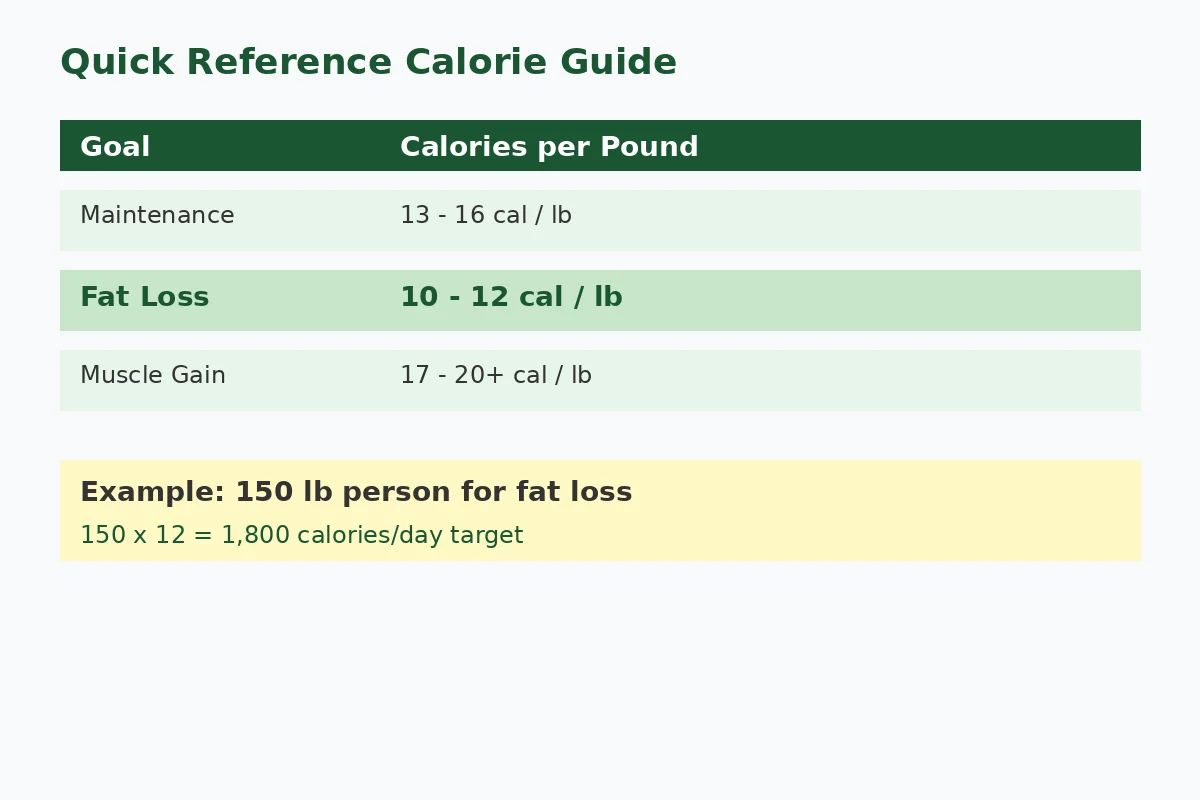
- Maintenance calories: 13–16 calories per pound of body weight
- Fat loss: 10–12 calories per pound of body weight
- Muscle gain: 17–20+ calories per pound of body weight
Say you weigh 150 pounds. Multiply by 12, and your fat loss target is 1,800 calories per day. Start at the upper end of the range — eat as much as you can while still losing fat.
If you’re not seeing consistent fat loss after two weeks, drop to 11 calories per pound and reassess in another few weeks.
The goal rate: half to one pound per week. Anything faster usually costs muscle or sustainability — sometimes both.
How big should your deficit be?
I recommend no more than a 500-calorie daily deficit for most people, with a carb refeed day built in once per week. Here’s how I classify deficit sizes:
- Small: minus 300 calories per day
- Moderate: minus 500 to 700 calories per day
- Large: minus 800 or more calories per day
The bigger the deficit, the harder it is to stick with. A massive deficit makes you hungry and increases muscle loss risk — especially if you’re already eating below 1,200 calories a day. That’s not a diet you survive; that’s a diet that survives you.
Don’t trust the treadmill
That number on your exercise machine screen is an estimate based on population averages — not on you specifically. A Stanford study tested popular wearable trackers and found the least accurate device was off by 93 percent, while the most accurate (Fitbit Surge) was still off by 27 percent.
Gym machines use the same rough estimation approach. Scientists averaged calorie data from test subjects running on treadmills with metabolic masks, then programmed that average into every treadmill sold. The result is useful if you happen to match the average person’s weight, muscle-to-fat ratio, effort level, and form. Which most of us don’t.
Do not eat back exercise calories based on machine readings. It’s a recipe for slowly undoing your deficit without noticing.
Finding your maintenance calories
Your maintenance intake is the number of calories you need to eat to hold your current weight steady. It varies day to day based on activity, sleep quality, stress, and even what you ate previously.
Four components make up your daily energy expenditure:
- BMR (Basal Metabolic Rate): what your body burns at complete rest — breathing, circulation, cell repair. This is the floor.
- TDEE (Total Daily Energy Expenditure): BMR plus everything you do during a day. This is your actual maintenance number.
- NEAT (Non-Exercise Activity Thermogenesis): all movement that isn’t deliberate exercise — walking to the train, pacing while on the phone, fidgeting.
- TEF (Thermic Effect of Food): energy burned through digestion. Small variable; don’t overthink it.
The 10-day tracking protocol
This is the most reliable way to figure out where you actually are, not where you think you are:
- Pick a tool. Use Cronometer, MyFitnessPal, or any macronutrient tracking app. Pen and paper works too, though apps reduce friction.
- Weigh your food. Not eyeballing it — weighing it with a kitchen scale. A "cup of coffee with cream and sugar" could be 10 calories or 120 depending on how generous you are. Two slices of toast changes if you butter them. Small differences stack up fast.
- Track everything for 10 days. Every bite, every sip that contains calories. No cheat days during this period — you’re collecting data, not dieting yet.
- Weigh yourself daily. Step on the scale each morning before eating, drinking, or moving — after using the restroom. Daily weight fluctuates 3 to 4 pounds based on food volume and water, so a single measurement tells you almost nothing. An average over 10 days tells you everything.
At the end of those 10 days, you’ll have two numbers: your average daily caloric intake and your average body weight. If your weight held steady, that calorie average is your maintenance. That’s your baseline for building a deficit.

The Science, Simplified
When researchers looked at how people actually eat and move versus how they think they eat and move, the pattern was consistent: we overestimate exercise burn by 3 to 4 times, and our reported food intake is substantially lower than reality. The fix isn’t willpower — it’s measurement. Track your food for two weeks with a scale, calculate your maintenance average, then subtract 300 to 500 calories. That’s the entire system.
The bottom line
A calorie deficit is not complicated. It is just rarely precise — and precision is what makes it work or fail.
Train with weights, eat slightly less than you burn, track honestly for a couple of weeks, and adjust from there. The research won’t make you lean by itself. Your next meal will. Pick your target number, log everything for 10 days, and let the data tell you what to do next.