
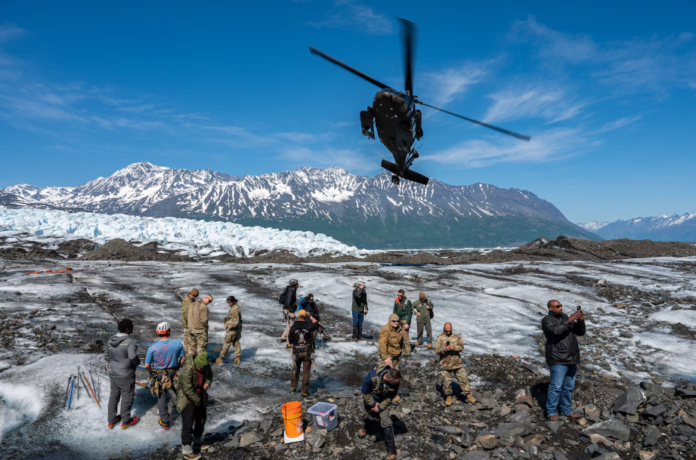
On the jagged, blue-and-white expanse of Colony Glacier in southern Alaska, twisted fragments of a plane lie frozen in time. Rusted springs, bent bolts, tires, and the massive remnants of a 28-cylinder propeller engine mark the spot where a C-124 Globemaster II military transport aircraft met its tragic end more than seventy years ago. In November 1952, 52 servicemen vanished in the Chugach Mountains, their fates sealed under layers of snow and ice. Now, thanks to a warming climate, some of those lost lives are slowly resurfacing.
For over a decade, teams have returned every summer to the glacier, combing through ice and debris in hopes of recovering the remains of the fallen. On a clear afternoon last July, the search finally yielded a breakthrough: the remains of James Kimball, a crew member whose identity had eluded investigators for decades. The discovery was almost accidental. Captain Kinsea Ragland, overseeing Air Force Mortuary Affairs operations, spotted a dark mass frozen into a ridge of ice about 60 feet above her. When colleagues climbed to investigate, they uncovered a flight jacket and, astonishingly, a right hand and forearm—remarkably preserved despite decades in the ice.
Kimball’s identification was notoriously difficult. With no living relatives providing DNA samples, conventional methods had failed. Yet the hand, so well preserved that its fingerprints were immediately visible, provided a critical clue. Medicolegal investigator Carlos Colon photographed the prints and sent them to the FBI. The confirmation came soon after: Kimball was the fiftieth serviceman from the crash to be identified.
The efforts at Colony Glacier are part of a broader phenomenon unfolding across the world’s melting icefields. Alaska alone harbors the remnants of multiple crashes, including a 1952 C-119 Flying Boxcar on Eldridge Glacier, whose fragments are only now beginning to surface. Volunteers, scientists, and military personnel across Alaska and neighboring Canada are actively searching for remains from other long-lost planes. “We’re talking about dozens of aircraft,” says Michael Rocereta, a retired geophysicist who has helped locate wreckage from several of these crashes.
The story is mirrored in Europe. In the Alps of Switzerland and Italy, centuries-old remains are emerging as glaciers recede. Mountaineers regularly encounter the skeletons of missing climbers and soldiers from World War I, while older discoveries include the 1690 remains of a young shepherd on Porchabella Glacier and the 5,200-year-old ice mummy Ötzi, who was found with his copper ax, quiver, and unfinished longbow. Glaciers, as Matthias Huss, a glaciologist at ETH Zurich, puts it, “decide to return what they want to return, when they want to return it.”
Alaska’s Colony Glacier illustrates the slow, inexorable movement of ice over decades. The C-124 crashed into Mount Gannet on a dark November evening, blown off course by high winds. Within seconds, the 175,000-pound aircraft disintegrated, triggering an avalanche that swept debris onto the upper glacier. Subsequent snowfall buried the wreck beneath hundreds of feet of ice, which over the years flowed downstream, crushing fragments in the Colony Ice Fall and scattering them across lower elevations.
It wasn’t until 2012 that the wreck resurfaced. An Alaska Army National Guard helicopter spotted remnants of a yellow life raft and a landing gear tire, confirming the long-lost C-124. Subsequent expeditions uncovered personal items—ID cards, dog tags, wallets, rings—and, eventually, bones and mummified body parts. DNA testing allowed these pieces to be matched to the lost servicemen, gradually restoring their identities after more than six decades. By 2024, 48 of the 52 passengers had been identified. Later discoveries, including Bernis White’s class ring and a wallet containing a photograph of a loved one, brought the number closer to completion. Kimball’s hand ultimately brought the tally to fifty, with DNA testing of newly recovered fragments revealing the identities of the final two servicemen. On January 7, the Air Force announced that all 52 had been accounted for.
Climate change has accelerated this process. Though Alaska’s glaciers are massive, they are melting faster each summer, shedding 10 to 30 feet of ice at lower elevations. Warming has likely revealed remains years earlier than they would have naturally surfaced, while also turning the search into a race against time. As the glacier slides forward into a sprawling lake, any unrecovered remains risk being lost forever to the icy depths.
Yet amid this sobering reality, there is a profound human story. Each recovered fragment tells a tale of courage, sacrifice, and the passage of time. Investigators like Ragland and Colon often immerse themselves in the lives of those they seek. In Kimball’s case, a steward from Taos, New Mexico, with no surviving relatives, the preservation of a single hand allowed a name to be restored to history. “It was time for us to find Kimball,” Ragland reflects, marveling at the glacier’s unpredictable rhythms.
Across the globe, melting ice continues to reveal the past—planes, climbers, and forgotten travelers—turning glaciers into both archives and time capsules. In Alaska, the thawed remains of the C-124 remind us that the effects of climate change are not just environmental, but deeply human, giving names and stories back to those who were once lost to the ice.