
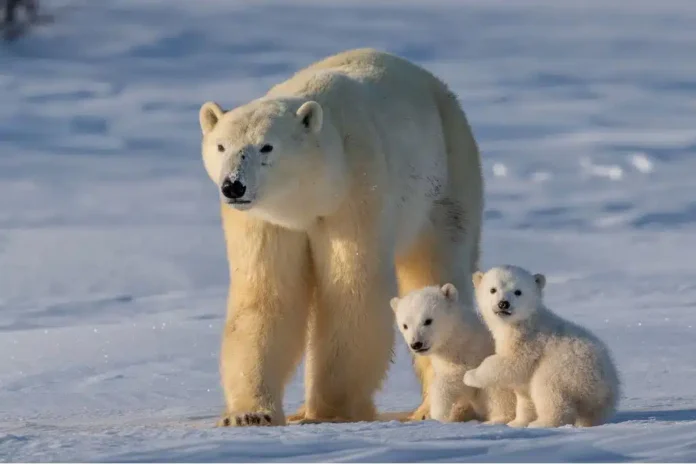
In the stark, frozen expanses of the Arctic, where shimmering auroras dance across the night sky and the wind carries a biting chill, the polar bear reigns as both a majestic predator and a poignant emblem of our planet’s environmental challenges. Known scientifically as Ursus maritimus, these animals are more than mere symbols—they are crucial participants in the delicate Arctic ecosystem. Their iconic white fur, composed of hollow translucent hairs, paired with a thick layer of insulating blubber, provides not only warmth against the unforgiving cold but also camouflage on ice and snow, making them highly effective hunters in a landscape of extremes.
Polar bears are the largest members of the bear family. Adult males can weigh up to 1,500 pounds (680 kg), while females generally reach around 800 pounds (363 kg). Across the Arctic, they inhabit 19 distinct subpopulations, each intricately linked to the sea ice that serves as both their hunting ground and transportation network. Seals, their primary prey, are accessed via this frozen platform, underscoring the polar bears’ dependence on a habitat that is increasingly under threat.
The Sea Ice Dilemma
Climate change has triggered a perilous shift in the Arctic. Rising temperatures have caused sea ice to form later in the year and melt sooner, truncating the polar bears’ hunting season. This disruption reduces access to the high-fat prey necessary for survival, affecting their overall health, reproductive success, and long-term population viability. Current estimates suggest that between 22,000 and 31,000 polar bears roam the Arctic, a number already considered fragile. The International Union for Conservation of Nature (IUCN) has classified them as “Vulnerable,” signaling that without swift and effective intervention, their future is uncertain.
As their natural habitat recedes, polar bears are increasingly venturing closer to human settlements in search of food, heightening the risk of human-wildlife conflict. This convergence is a stark reminder that climate change does not operate in isolation—it reverberates through ecosystems and communities alike.
Life on Land: A Harsh Reality
Recent studies, particularly from Western Manitoba, highlight the extreme challenges polar bears face when forced onto land for extended periods. Deprived of their primary prey, some individuals lose up to 11% of their body mass, an alarming indicator of nutritional stress. Attempts to adapt—whether through resting longer to conserve energy, foraging for sparse vegetation or berries, or swimming in search of food—have proven largely inadequate. Unlike seals, which are fat-rich and energy-dense, terrestrial food sources offer minimal sustenance, and polar bears cannot feed while swimming, compounding their struggle to survive in a rapidly warming Arctic.
The image of a starving polar bear stranded on diminishing ice has become an iconic representation of climate change’s immediate impact. These scenarios illustrate the vulnerability of a species finely tuned to its environment yet increasingly at odds with the shifting climate.
Conservation Efforts: A Global Responsibility
Conservation initiatives targeting polar bears are multifaceted and international in scope. The 1973 Polar Bear Agreement, signed by Arctic nations, laid the foundation for cooperative research and conservation efforts across national boundaries. Today, these initiatives have expanded to focus on broader climate solutions, such as reducing global greenhouse gas emissions, protecting critical habitats, and managing human activities to minimize conflicts with polar bears.
Beyond policy and research, the polar bear continues to captivate the human imagination. Their fur, though appearing white, is translucent, reflecting visible light, while the black skin underneath absorbs heat to aid in thermoregulation. Polar bear mothers give birth in snow dens, shielding their cubs from extreme cold until they are strong enough to venture outside. Adults are known to traverse extraordinary distances in search of food, demonstrating remarkable endurance and adaptability. These traits highlight not only the species’ resilience but also its vulnerability to environmental disruption.
A Broader Message
The struggle of polar bears resonates far beyond the Arctic. Their plight illustrates the interconnectedness of Earth’s ecosystems and the profound consequences of human-induced climate change. As ice sheets retreat and hunting seasons shorten, the polar bear becomes a stark symbol of urgency—an animal whose survival depends directly on global environmental stewardship.
Continued scientific research, active conservation strategies, and a global commitment to reducing carbon emissions offer hope. While the challenges are immense, there remains potential for these Arctic giants to thrive. Protecting polar bears is not merely about preserving a species; it is about safeguarding the intricate web of life that binds our planet together.
In witnessing the endurance and majesty of polar bears, we are reminded that climate change is not an abstract threat—it is a tangible reality with direct consequences for wildlife and humanity alike. Their story is a call to action, a compelling argument for sustainable living, and a testament to the beauty and resilience of nature that demands our protection. The survival of these Arctic icons is a shared responsibility, one that reflects the broader imperative to preserve the diversity and splendor of life on Earth for generations to come.