
This winter, California has experienced a series of astonishingly rapid weather swings—transitions that feel almost cinematic in their extremity. After enduring nearly 40 days of unseasonably warm, dry conditions, the state’s mountains were suddenly deluged with snow, including heavy accumulations at unusually low elevations. This brief but intense snowy interlude offered both a relief and a stark reminder of the dangers posed by rapid climatic shifts.
A Snowy Anomaly Amid a Warm Winter
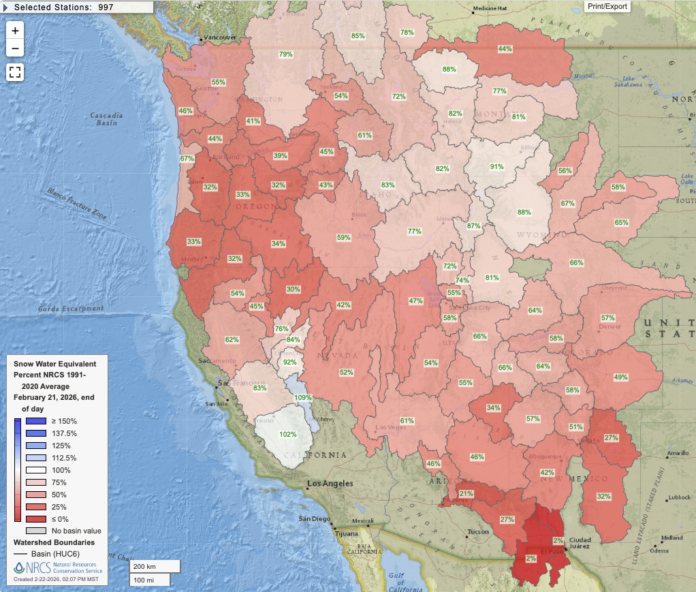
Despite last week’s dramatic snowfall, most of the Western United States remains well below average in snowpack. California’s central and southern Sierra Nevada and portions of the northern Rockies in Montana and Wyoming stand out as exceptions, but regions such as the Colorado River basin continue to struggle with persistently low snow levels. Even with the recent snow, large portions of the West are experiencing one of their driest winters on record.
The sudden Sierra snowfall followed a prolonged warm stretch, during what is still officially the warmest winter on record across much of the West. The storm disrupted travel throughout the mountains, closing major highways and catching many unprepared drivers and adventurers off guard. Yet the most devastating consequence of this abrupt weather change was human: near Castle Peak, close to Donner Summit, an avalanche claimed nine lives. This tragic event marks the deadliest avalanche in California’s modern history and the most fatal in the United States since 1981.
The conditions leading to this catastrophe were well understood: a fragile, icy snow base formed during weeks of warm temperatures and freeze-thaw cycles, followed by a sudden storm depositing four to six feet of snow over a few days. The resulting snow slabs were extremely unstable, and one ultimately struck the path of a ski group, resulting in the fatalities. Avalanche risk had been forecasted, with warnings issued by both the National Weather Service and the Sierra Avalanche Center. These warnings, however, could not prevent the tragedy, underscoring the inherent dangers of the backcountry in the wake of such extreme weather swings.
Record-Setting Snow and Its Impacts
While the snowfall did not break statewide records, it ranked among the top ten for certain locations on the western slopes of the Sierra. The Central Sierra Snow Lab recorded its 10th snowiest 24-hour period and 9th snowiest 72-hour period on record. Most strikingly, a five-day accumulation of 111 inches ranks as the third-highest over such a period. Factors contributing to these totals included topographical lifting, orographic enhancement, and even localized convective activity—producing rare thundersnow events amid a storm that also brought damaging winds to parts of Southern California.
High-elevation snowpack in the central and southern Sierra Nevada now sits at near or above-average levels for this time of year, offering a boost to California’s water supply. Lower elevations, along with the northern Sierra and Shasta Mountains, remain below average. Elsewhere in the West, snowpack conditions improved only marginally. The Pacific Northwest, Great Basin, and central/southern Rockies remain dangerously low in snow, with many areas near record lows. The Colorado River Basin continues to face severe water scarcity.
The Next Weather Shift: Warm, Moist Air Approaches
As California’s mountains settled under their new snow blanket, a remarkably warm and moist atmospheric river began aiming toward Northern California. Originating from the subtropics, this plume of air carries near-record levels of water vapor. While social media buzz has emphasized its potential danger, the risk of extreme flooding is mitigated by weak storm dynamics. Without a strong low-pressure system near the coast, the moisture will largely be released gradually via orographic lifting. Precipitation will mostly be rain, with snow levels soaring above 10,000 feet. Localized flooding may occur in lower-elevation snowpacks or urban areas with clogged drains, but the event is unlikely to produce widespread or severe flooding.
Interestingly, thick high-elevation snowpacks will absorb a significant portion of the rain, refreezing it and temporarily enhancing water storage. While these conditions pose some avalanche risk, particularly wet slab avalanches, they also act as a natural buffer against catastrophic runoff.
A Return to Warmth and Drying
Following the atmospheric river, California will swing back to anomalous warmth and drying. Southern California will experience spring-like temperatures, with highs potentially in the 70s and even low 80s. Northern California will also warm considerably, with valley and coastal temperatures reaching the 60s and 70s. Mountain snowpack will begin to melt in earnest as “warm and damp” conditions gradually transition to “warm and dry.”
This cycle of whiplash weather—a swing from prolonged warmth to heavy snow and back to heat—exemplifies the volatility of California’s winter climate. While this recent snowfall has temporarily lifted the state out of its multi-year drought, other parts of the West continue to face severe snow deficits and water scarcity. Looking ahead, the likelihood is for a quieter, warmer period across much of the West, which could further exacerbate the ongoing snow drought in the Intermountain West.
Lessons and Reflections
California’s winter has highlighted the double-edged nature of extreme weather: while snow brings relief and water security, it also carries serious hazards when shifts are abrupt. Avalanche awareness, careful monitoring, and respect for natural forces remain essential, particularly for those venturing into backcountry terrain. Meanwhile, the broader Western U.S. continues to grapple with chronic low snowpack, reminding us that even amid spectacular local storms, regional drought and water scarcity remain pressing concerns.
In a single week, California experienced one of its warmest winters on record, a historic snowstorm, and the approach of a near-record atmospheric river—all signaling the volatility of a changing climate. For residents and adventurers alike, the message is clear: prepare for the unexpected, and respect the mountain’s power, no matter the season.