
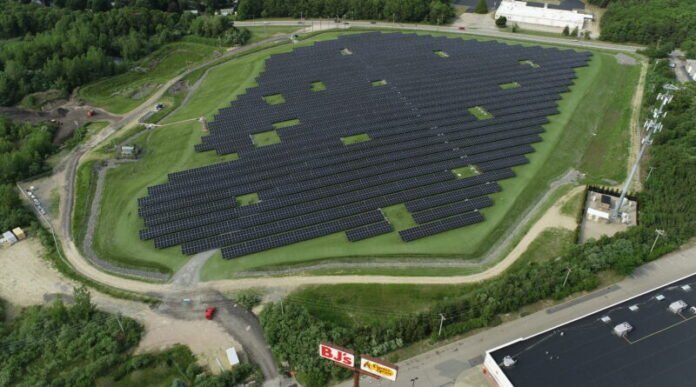
In a quiet but powerful example of smart land reuse, a former landfill in Rhode Island has been transformed into a productive source of clean energy. The newly completed Coventry Landfill Solar project stands as proof that yesterday’s environmental burdens can become tomorrow’s climate solutions.
At the heart of the project is a 5.741-megawatt (DC) solar array, now fully operational atop land that once served as a waste disposal site. Instead of leaving the capped landfill idle — a common fate for such properties — developers saw an opportunity. Why search for undeveloped land, navigate permitting hurdles, and alter natural landscapes when an already-disturbed site could serve a new purpose?
That simple but powerful idea — using land that can’t easily support housing, agriculture, or commercial development — is what makes landfill solar projects especially compelling. They require no deforestation, no displacement, and no conversion of active green space. In this case, the approach avoided the need to acquire and transform additional land, preserving surrounding areas while still expanding renewable energy capacity.
From Waste to Watts
The landfill’s journey to becoming a solar power site didn’t happen overnight. According to Jonathan Mancini, Senior Vice President of Solar & BESS Project Development at Ameresco, several factors paved the way for the successful transition.
A key turning point came when the site’s remediation plan — approved by the Rhode Island Department of Environmental Management — included provisions that anticipated future solar development. Rather than treating closure as the final chapter, planners built flexibility into the design.
The landfill was officially capped in 2020 using WatershedGeo® ClosureTurf®, an advanced closure system that not only stabilizes and protects the underlying waste but also supports more efficient installation of solar infrastructure. This foresight made it significantly easier to deploy solar panels without compromising the integrity of the cap.
By the end of 2025, the transformation was complete.
Powering Homes, Cutting Emissions
The new solar installation is expected to generate approximately 7,725,000 kilowatt-hours of electricity in its first year alone. To put that into perspective, that’s enough energy to power roughly 600 homes.
But the benefits go beyond electricity production. In its first year of operation, the project is projected to prevent 3,759 tons of carbon dioxide emissions. Over a 25-year lifespan, the avoided emissions are estimated at 88,545 tons, based on calculations from the EPA Greenhouse Gas Equivalencies Calculator.
For a small state like Rhode Island, projects of this scale meaningfully contribute to broader clean energy and climate goals. Every megawatt installed on underutilized land helps accelerate the shift away from fossil fuels while minimizing environmental trade-offs.
Local Jobs and Local Dollars
Clean energy projects often promise economic growth alongside environmental progress. In Coventry, that promise translated into real numbers.
During the construction phase, approximately 77 electrical and civil workers were employed on-site. In addition, around 15 part-time support staff contributed to the effort. These are tangible, local jobs — from skilled tradespeople to support personnel — supporting families and injecting money into the regional economy.
Beyond short-term employment, the project is expected to deliver an estimated $4.4 million in economic benefits to the town. Most of that value comes from lease rental payments and property tax revenue. For municipalities balancing budgets and investing in services, stable revenue streams tied to renewable energy projects can be especially valuable.
This financial return illustrates an important point: environmental responsibility and economic development are not mutually exclusive. In many cases, they reinforce one another.
Collaboration Makes It Possible
Landfill solar projects require coordination among multiple stakeholders — municipal officials, state regulators, engineering teams, environmental specialists, and private developers. The Coventry project highlights how alignment among these groups can lead to outcomes that serve both the environment and the community.
By incorporating solar considerations into the remediation plan years in advance, regulators and planners ensured that clean energy could become part of the site’s future. By choosing a closure system compatible with solar infrastructure, engineers reduced technical barriers. And by committing capital and expertise, developers brought the project across the finish line.
This type of collaboration is increasingly important as communities look for practical ways to expand renewable energy without sparking land-use conflicts.
A Model for Smart Redevelopment
Across the United States, thousands of capped landfills sit idle. While not every site is suitable for solar development, many are. The Coventry Landfill Solar project offers a blueprint for how these underutilized properties can be repurposed in a way that generates power, revenue, and climate benefits.
It also reframes how we think about legacy waste sites. Instead of seeing them solely as environmental liabilities, communities can view them as assets — platforms for renewable energy that help offset the very environmental impacts industrial development once created.
There is something symbolically powerful about generating clean electricity from land that once represented consumption and disposal. It signals a shift in mindset: from extract-and-discard to restore-and-repower.
For residents of Coventry and the broader Rhode Island community, the project delivers immediate, measurable gains — electricity for hundreds of homes, millions in economic benefit, and tens of thousands of tons of avoided carbon emissions over time.
For the clean energy sector, it’s another success story demonstrating that innovation isn’t always about building something entirely new. Sometimes, it’s about looking at what we already have — even a former landfill — and imagining a better future.
As more communities confront climate challenges and land-use constraints, projects like this one show that smart planning, collaboration, and a bit of creative thinking can turn yesterday’s waste into tomorrow’s watts.