
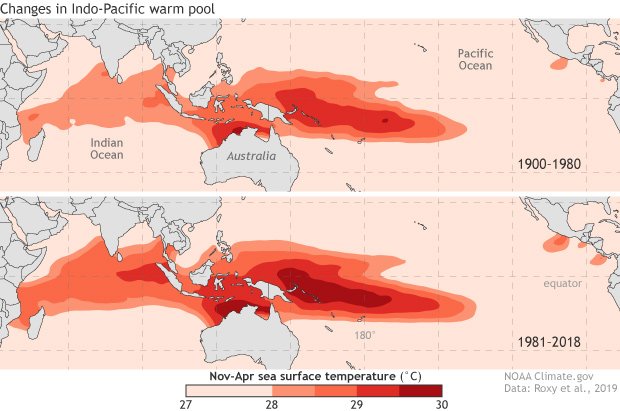
Over the past century, the world’s oceans have quietly been heating up. On average, ocean temperatures have risen by about 0.06°C (0.11°F) per decade—a seemingly small change with monumental consequences. But this warming is far from uniform. Recent research funded by NOAA reveals that a particularly critical region—the Indo-Pacific Warm Pool—has not only grown hotter but has nearly doubled in size since 1900, reshaping weather patterns and influencing rainfall around the globe.
A Vast Swath of Persistent Warmth
The Indo-Pacific Warm Pool spans the Indian Ocean and the western Pacific, and it is defined by waters that remain above 28°C (82.4°F) year-round. Historical comparisons of sea surface temperatures show a dramatic expansion: from 1900 to 1980, the pool expanded by roughly the size of Washington State each year (230,000 km² / 88,800 mi²). In the most recent decades, from 1981 to 2018, this expansion has accelerated, adding an area equivalent to California annually (400,000 km² / 154,000 mi²).
Notably, the warming is uneven. The western Pacific is heating faster than other areas, creating a patchwork of temperature differences across the region. These contrasts are more than a curiosity—they amplify cloud-forming winds, increase atmospheric moisture, and draw warm, humid air from the Indian Ocean, fundamentally altering the dynamics of the atmosphere above.
Warping a Key Global Weather Pattern
One of the most profound consequences of this expanding Warm Pool is its impact on the Madden-Julian Oscillation (MJO). This large-scale tropical weather pattern, active mainly in winter, consists of a wave of clouds, winds, rainfall, and pressure that originates over the Indian Ocean and moves eastward around the tropics in cycles of 30 to 60 days.
The new research shows that while the MJO’s overall journey remains roughly the same in length, its behavior has shifted. Clouds and rainfall now linger 3–4 fewer days over the Indian Ocean and 5–6 more days over the Maritime Continent and western Pacific, where the ocean has warmed more intensely. Essentially, the MJO has been nudged off course, guided by pockets of heat and moisture in the growing Warm Pool.
This shift may seem distant, but it has consequences far beyond the tropics. As the MJO travels, it interacts with global atmospheric circulation patterns. Its influence can ripple across the world, affecting monsoons, the El Niño–Southern Oscillation, tropical cyclones, and even extreme weather events thousands of miles away—including U.S. heat waves and snowstorms.
Rainfall Patterns Around the World Are Shifting
The expanding Warm Pool is already linked to noticeable changes in global precipitation. Regions experiencing drier winters and springs include the east and west coasts of the United States, Ecuador, the central Pacific, China’s Yangtze basin, northern India, and eastern Africa. Conversely, areas such as the Amazon basin, northern Australia, Southeast Asia, and southwestern Africa are seeing wetter conditions.
While researchers caution that not all of these changes can be definitively attributed to the MJO, it is clear that the Warm Pool itself plays a key role in reshaping global rainfall patterns. Its influence on large-scale atmospheric circulation may be driving shifts in precipitation independently of the MJO’s path.
Looking Ahead
Climate models predict that ocean warming will continue in the coming decades, suggesting that the impacts on the Warm Pool, the MJO, and global rainfall patterns may intensify. For scientists, this presents both a challenge and an opportunity: understanding the complex interplay between oceans and the atmosphere is crucial to predicting future weather extremes and preparing for the societal impacts of shifting rainfall.
This research, supported by NOAA’s Climate Program Office and its Climate Variability and Predictability (CVP) Program, represents an international collaboration involving NOAA and India’s Ministry of Earth Sciences, facilitated by the National Academy of Sciences. By mapping the evolving Warm Pool and its effects, scientists are piecing together a more comprehensive picture of how subtle ocean changes ripple outward to affect weather and climate around the globe.
In short, a warm stretch of ocean thousands of miles away is quietly steering storms, droughts, and monsoons. As the Indo-Pacific Warm Pool continues to expand, understanding its influence may be key to navigating a world where weather extremes are becoming the new normal.