
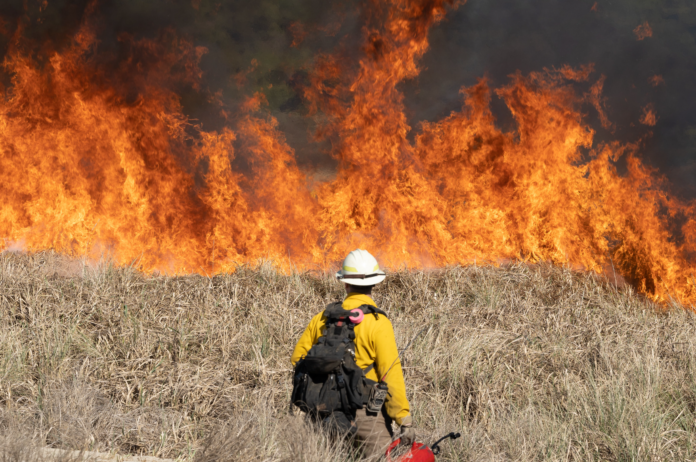
In a move aimed at streamlining wildfire response, the U.S. Department of the Interior officially unveiled the U.S. Wildland Fire Service on Monday, marking a new chapter in the nation’s approach to combating wildfires. The initiative seeks to consolidate the firefighting forces scattered across multiple Interior sub-agencies, including the National Park Service, Bureau of Land Management, Bureau of Indian Affairs, and the U.S. Fish and Wildlife Service.
The announcement follows a September declaration by Secretary of the Interior Doug Burgum, who outlined the department’s intention to establish a unified wildfire-fighting service. This effort builds on a June executive order by President Donald Trump, which directed all agencies represented by the National Interagency Fire Center to strengthen and coordinate their wildland firefighting capabilities.
Despite the ambitious vision, the new Service faces immediate hurdles—most notably a glaring lack of funding. Congress recently blocked the proposed financing for the agency, leaving it with zero dollars in the latest appropriations bill. The Department had requested roughly $6.5 billion to support wildfire operations, but lawmakers, citing concerns about the consolidation plan, chose instead to maintain the existing system of funding the U.S. Forest Service and Interior firefighting units separately.
In a statement, Democratic members of the Senate Appropriations Committee emphasized their reservations:
“The bill does not endorse the consolidation of federal wildland firefighting into one agency as proposed in President Trump’s budget request. Instead, it provides funding to continue wildland firefighting using the longstanding practice of funding both the U.S. Forest Service and the Department of the Interior, allowing Congress to consider legislative proposals for such a major change.”
Monday’s launch announcement notably sidestepped any mention of the funding shortfall, leaving questions about how the Service will operate in practice.
Adding to the complexity, the Service’s name may be somewhat misleading. The vast majority of America’s wildfire-fighting resources—over two-thirds—remain under the jurisdiction of the U.S. Forest Service, which is not included in the new agency. While lawmakers have expressed interest in eventually merging the Forest Service into the Wildland Fire Service, such a move would require formal congressional approval, meaning full integration could be years away.
The creation of the U.S. Wildland Fire Service reflects a broader trend toward centralization and efficiency in federal emergency response. By bringing together the Interior Department’s firefighting units under a single umbrella, proponents argue the Service could enhance coordination, reduce duplication of effort, and improve rapid response to increasingly severe wildfire seasons. However, without dedicated funding or the inclusion of the nation’s largest firefighting force, skeptics question whether the agency can fulfill its mission effectively.
Secretary Burgum has framed the launch as a forward-looking step in addressing America’s wildfire challenges, emphasizing collaboration across federal agencies. “This is about creating a unified team that can respond more quickly and effectively when fires threaten public lands and communities,” Burgum said in a statement last fall. Yet the absence of operational resources and congressional backing casts a shadow over the Service’s immediate viability.
The political divide surrounding the consolidation highlights deeper tensions over how the federal government should manage wildfire response. Advocates of the new Service argue that fragmented authority has historically slowed coordination and hampered efforts during major fire events. Critics, however, warn that centralizing authority could introduce bureaucratic inefficiencies and disrupt the well-established practices of existing agencies.
For now, the U.S. Wildland Fire Service exists largely on paper, symbolizing a vision of a more unified federal firefighting infrastructure—but one that remains untested. Its success may hinge not only on future funding and legislative approval but also on the ability to integrate complex operations across multiple agencies while gaining the trust of local firefighters and communities.
As wildfire seasons grow longer and more intense across the United States, the debate over how to organize federal firefighting resources is likely to intensify. Whether the U.S. Wildland Fire Service can evolve into a fully operational force capable of meeting the nation’s wildfire challenges remains to be seen—but its creation underscores the urgency of rethinking how America fights its most destructive natural disasters.