
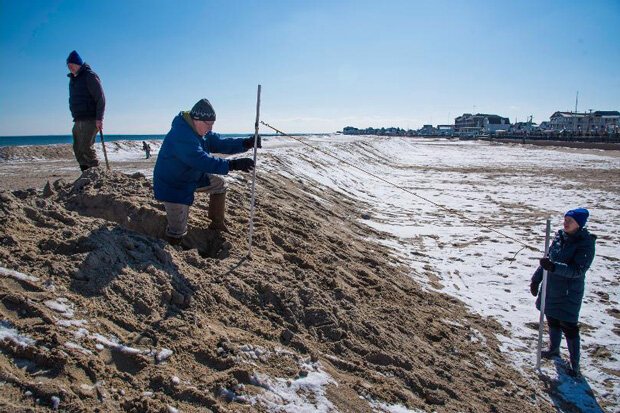
On a chilly February morning in Hampton, New Hampshire, the beach was alive with the usual winter wanderers: dog walkers and early risers braving temperatures barely above forty degrees. Yet near the water’s edge, another group had gathered, not for leisure, but for a mission that combined curiosity, science, and community service. Armed with long red-and-white striped poles connected by a yellow rope, volunteers surveyed the sands, preparing to document the subtle—and sometimes dramatic—shifts in the coastline.
Mike and Terry Stockdale, Sherri Townsend, and Marc Tosiano are members of the Coastal Research Volunteer program, and this stretch of Hampton Beach, labeled HB02 on their datasheet, is their charge. Month after month, they record the beach’s profile: the slope and shape of sand as it arcs from boardwalk to surf. Their work traces the rhythms of storms, tides, and seasonal changes, providing a snapshot of a landscape continually reshaped by nature.
A Nationwide Effort Through Sea Grant
Hampton Beach’s volunteers are part of a broader initiative supported by the National Sea Grant College Program (Sea Grant), a NOAA-funded network spanning the United States’ coastal and Great Lakes states. Sea Grant programs balance the conservation of marine resources with sustainable economic development, supporting research, education, and community outreach.
From New Hampshire to Maine and California, Sea Grant relies on citizen scientists to collect critical data about the health and erosion of sandy beaches. Volunteers measure beach slopes using two-meter poles, a short connecting rope, and the horizon line. One volunteer crouches to align the top of a seaward pole with the horizon while the other holds the landward pole, then leapfrogs down the beach to track changes in elevation. Simple to learn and inexpensive to implement, this method has generated essential data on the effects of storms, sea-level rise, and climate change.
Learning from Harsh Winters
Southern Maine’s volunteer beach monitoring program traces its roots to the Blizzard of 1978, which dramatically reshaped the state’s sandy beaches. Though Maine is often thought of as rocky, its southern beaches are vital for tourism, drawing visitors whose spending supports the local economy. The blizzard’s sudden transformation of dunes and sandbanks prompted stricter policies on construction and development, emphasizing the need for careful management of these fragile shorelines.
Over the years, nearly four hundred volunteers have participated in Maine’s program. Coastal towns fund the monitoring, gaining detailed insight into beach changes as storms intensify and sea levels rise. For locals like Betsy Smith, who has tracked Gooch’s Beach in Kennebunk for five years, observing these shifts has deepened her connection to the landscape. “We see the beach in all weather, winter and summer,” she says. “Visitors don’t—they’re blissfully unaware of the changes underway.”
The data collected informs dune restoration, beach nourishment, endangered species management, and even decisions about shoreline armoring. For meteorologists like John Cannon of the National Weather Service in Gray, Maine, volunteer data has been invaluable, helping calibrate erosion forecasts during Nor’easters—powerful winter storms capable of reshaping beaches almost overnight.
Responding to Storms in Real Time
Volunteers often act as the eyes on the ground when extreme weather strikes. In early 2018, three Nor’easters hit New England in quick succession, with winds approaching 100 miles per hour in Massachusetts, accompanied by record tides and heavy snowfall. The storms left beaches stripped bare, forcing volunteers into action to document the changes.
In New Hampshire, data collected after these storms informed state legislators, coastal managers, and municipal authorities, illustrating the effects on natural infrastructure like dunes and beaches as well as built structures such as roads and sea walls. Tracking the recovery of these systems over time allows communities to plan for future storm impacts and adapt strategies accordingly.
California’s Beaches at Risk
On the West Coast, California faces its own coastal challenges. Monique Myers, a California Sea Grant specialist, warns that up to two-thirds of the state’s beaches could disappear by 2100 due to rising seas. Programs like the Community Alliance for Surveying the Topography of Sandy Beaches (CoAST SB) offer residents a chance to participate in data collection and climate adaptation efforts. Modeled after Maine’s program, CoAST SB equips citizen scientists to track beach changes, contributing to USGS shoreline models and local planning initiatives.
For residents like Kevin Parent of Santa Barbara, participating in CoAST SB provided a tangible way to respond to climate threats. In January 2018, a mudslide triggered by the Thomas Fire—a massive wildfire compounded by drought and heavy rainfall—swept through Montecito, transforming nearby Summerland Beach. Parent and his family measured the altered sands, documenting debris and sediment deposition. “We were there, we were measuring it,” Parent said. “We wouldn’t have gone to the beach that day otherwise, except out of social responsibility.”
The Power of Citizen Science
Whether in Maine, New Hampshire, or California, volunteers play a critical role in understanding coastal change. Their measurements inform restoration projects, improve forecasting, and provide a holistic record of how storms, sea-level rise, and human activity reshape our beaches. Programs like these rely on regular, consistent participation, and volunteers’ efforts translate directly into actionable scientific data.
“I am filled with awe and gratitude that we have a large group of volunteers willing to give their time and energy, on packed summer beaches and in freezing winter winds,” says Alyson Eberhardt of New Hampshire Sea Grant. “They are the front line of observing and understanding our coasts, and their contributions are invaluable.”
As storms intensify and sea levels rise, these volunteers stand as vigilant witnesses, documenting a landscape in flux and helping communities plan for a future shaped by both nature and human activity. Their work demonstrates the power of local action in the face of global environmental challenges, proving that citizen science is more than data collection—it is a form of stewardship, a shared responsibility for the shores we love.