
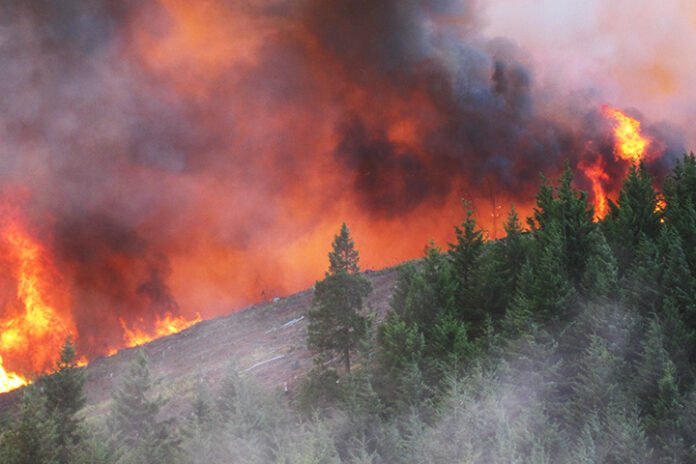
Wildfires have always been part of Earth’s natural rhythms. They clear old growth, recycle nutrients, and shape ecosystems over time. But in recent decades, something has shifted. As the planet warms, fires are no longer behaving in familiar ways. They are igniting more often, burning longer, and growing larger—especially across northern and temperate forests.
From space, this transformation is visible in real time.
Satellites operated by NASA orbit Earth daily, detecting heat signatures and smoke plumes from active fires. Instruments aboard the Terra and Aqua satellites scan the globe twice a day, identifying hotspots that signal fire activity. These observations are compiled into tools like the FIRMS (Fire Information for Resource Management System), which allows scientists, land managers, and emergency responders to monitor fires as they unfold.
What this long-term view reveals is striking: extreme wildfire activity has more than doubled worldwide over the past two decades.
Bigger, Hotter, and Harder to Stop
A 21-year analysis of satellite records found that the most severe fires are becoming more frequent, more intense, and larger in size. The most dramatic increases are occurring in temperate conifer forests of the western United States and in boreal forests stretching across northern North America and Russia.
One key factor stands out: warmer nights.
In the past, cooler nighttime temperatures often slowed a fire’s advance, giving firefighters a critical window to contain flames. Today, higher overnight temperatures allow fires to keep burning with little pause. Without that nightly reprieve, fires can expand rapidly and behave unpredictably.
A vivid example occurred in Quebec, Canada, in June 2023. Satellite imagery captured eight days of explosive growth. What began as a cluster of hotspots spanning just a few miles quickly ballooned into a blaze tens of miles across in under a week. The speed and scale of expansion illustrated a new reality—fires are no longer confined by the boundaries that once restrained them.
The Expanding Fire Season
Wildfire season used to conjure images of late summer heat. Now, it increasingly stretches beyond traditional limits.
In 2021, a destructive wildfire ignited in Colorado during winter—an event that would once have seemed improbable. But long-term weather data tells a broader story. Over the past 35 years, fire seasons have started earlier in spring and lingered later into autumn. In parts of the western United States, Mexico, Brazil, and East Africa, the fire season has lengthened by more than a month compared to the late 20th century.
Several climate-related shifts are driving this expansion:
- Hotter average temperatures
- Earlier snowmelt
- Warmer nighttime conditions
- Reduced summer rainfall
Among these, summertime precipitation plays an especially crucial role in the western U.S. Even modest declines in rainfall can dramatically increase the total area burned in a given year.
As dry conditions persist for longer periods, landscapes remain primed for ignition. A stray lightning strike or a spark from human activity can trigger fires that spread across vast areas.
Fire and the Carbon Cycle
Wildfires do more than reshape forests—they also influence the atmosphere.
When trees and vegetation burn, they release carbon dioxide and other gases that were stored in plant matter. Globally, carbon emissions from forest fires have increased by about 60% between 2001 and 2023. In boreal forests of Eurasia and North America, fire-related emissions nearly tripled during that time.
The 2023 Canadian wildfire season offers a sobering illustration. That year brought Canada’s warmest and driest conditions since 1980. Fires burned for five months, releasing an estimated 640 million metric tons of carbon into the atmosphere. Alongside carbon dioxide, significant amounts of carbon monoxide were detected drifting across continents, affecting air quality far beyond the burn zones.
This creates a feedback loop. As climate change intensifies fires, those fires release more greenhouse gases, which in turn contribute to further warming.
Fire Weather and Human Influence
Weather has always shaped wildfire behavior. But recent research shows that the increasing prevalence of “fire weather”—conditions that favor ignition and rapid spread—is largely attributable to human-caused climate change.
In the American West, scientists have quantified the relative contributions of natural variability and human influence. While some climate swings are part of natural cycles, rising greenhouse gas concentrations are now the dominant driver of heightened fire risk.
At the same time, decades of fire suppression policies have added another layer of complexity. Throughout much of the 20th century, land management strategies aimed to extinguish all fires quickly. While well-intentioned, this approach allowed flammable materials—dead wood, brush, and dense undergrowth—to accumulate in many forests. Today, when hotter and drier conditions align with these fuel-heavy landscapes, the result can be explosive.
The convergence of built-up fuels and warming-driven dryness has created conditions ripe for extreme fire behavior.
Preparing for a New Normal
Although the trend lines are concerning, the growing body of satellite data provides a powerful advantage. Real-time fire detection improves emergency response and public safety. Long-term records help scientists understand how and where risks are evolving. Policymakers and land managers can use this information to design better forest management strategies, reduce fuel loads, and adapt to changing conditions.
Wildfires are no longer just seasonal hazards—they are emerging as defining features of a warming world. From the boreal forests of Canada to the mountain ranges of the American West, the evidence is clear: climate change is amplifying fire activity in measurable ways.
The view from space confirms what communities on the ground increasingly experience. As temperatures rise and dry spells lengthen, wildfires are becoming larger, longer-lasting, and more intense. Understanding this connection is the first step toward building resilience in an era where fire plays a more powerful role in shaping our planet’s future.