
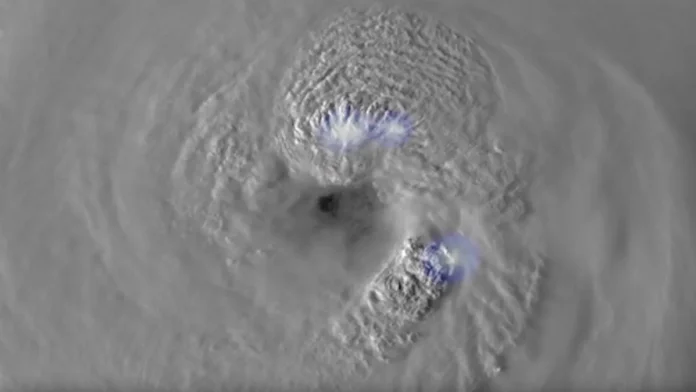
In late September 2024, as Hurricane Helene roared toward Florida’s Gulf Coast as a Category 4 storm, its 130-mph winds churning the sunset skies, it was hard not to ask a familiar question: Is this the new normal?
It’s a question that has echoed through many hurricane seasons over the past two decades. Some years feel apocalyptic. Others are eerily quiet. The science, as always, is more nuanced than the headlines.
Are more major hurricanes hitting the U.S.?
If we focus strictly on the continental United States, the long-term record going back to 1900 offers a surprising answer: there has been no statistically significant increase or decrease in the number of major (Category 3–5) hurricanes making landfall.
That might seem at odds with recent memory. Between 2017 and 2024, the U.S. endured an extraordinary stretch of powerful storms, including multiple Category 4 and 5 landfalls. It felt relentless. Yet the historical data show similar bursts of activity before — including a cluster of intense strikes in the late 1940s.
Hurricanes, as one veteran meteorologist famously put it, are like bananas: they come in bunches.
Atmospheric steering currents — the large-scale wind patterns that guide storms — shift over time. Some multi-year periods steer hurricanes harmlessly out to sea. Others aim them squarely at vulnerable coastlines. These patterns can flip because of natural variability or broader climate influences, and they often persist for years at a time.
The result? Long droughts punctuated by punishing streaks.
From 2006 to 2016, the U.S. experienced the longest stretch on record without a major hurricane landfall. Florida went a full decade without a single hurricane strike of any strength. Then the pendulum swung back hard.
The bigger Atlantic picture
While U.S. landfall numbers show little long-term trend, the story changes when we look across the entire Atlantic basin.
Since the mid-20th century, the number of major hurricanes in the Atlantic appears to have increased. That finding, however, comes with an important caveat: before satellites began providing comprehensive coverage in the early 1970s, some storms — particularly those that stayed at sea — may have gone undetected.
Researchers have tried to correct for these “missing storms” using ship logs and land observations. Some analyses suggest that once those gaps are accounted for, the long-term trend becomes less clear. Others, using climate models that simulate hurricane-favorable conditions, conclude that Atlantic tropical cyclone activity has indeed risen since 1900.
One intriguing line of evidence looks beyond the continental U.S. to include landfalls in the Caribbean, Mexico, and Central America — regions with reliable records stretching back well before the satellite era. There, the data show an upward trend in major hurricane landfalls since the 1940s.
Why might the U.S. not share that increase?
A 2025 study on shifting hurricane genesis found that storm formation in the Atlantic has migrated southward in recent decades — a shift consistent with human-driven climate change. A more southerly formation zone may favor Caribbean and Gulf impacts over East Coast strikes, helping explain why the U.S. mainland hasn’t seen a clear upward trend even as the broader basin grows more active.
In other words, geography matters — and so does where storms are born.
Cleaner air, warmer oceans
One of the more surprising contributors to recent Atlantic hurricane activity may be cleaner air.
Since the passage of the Clean Air Act in 1970, sulfate aerosol pollution over the North Atlantic has declined sharply. These fine particles, largely produced by fossil fuel combustion, once reflected sunlight back into space, slightly cooling ocean waters.
With fewer aerosols in the atmosphere, more sunlight reaches the ocean surface. The Atlantic has warmed — and warm water is hurricane fuel.
Many hurricane scientists believe this reduction in air pollution has played a meaningful role in the rise of Atlantic storm activity since the 1970s. Others assign lower confidence to the hypothesis. At the same time, there is broad agreement that greenhouse gas–driven ocean warming is increasing the potential intensity of the strongest storms.
Climate change does not necessarily create more hurricanes overall. But it is expected — and increasingly observed — to make the most powerful ones stronger.
It’s not just how many — it’s how strong
Even if the total number of U.S. landfalls hasn’t increased, the destructive potential of those storms has.
One way scientists measure this is through the Power Dissipation Index, which factors in wind speed at landfall. Research shows that the cumulative destructive energy of U.S. landfalling storms has risen significantly over the past century.
Put simply: when hurricanes hit, they are packing more punch.
A 2024 study found that recent Atlantic hurricanes had maximum sustained winds roughly 19 mph stronger, on average, than they would have been in a world without human-caused climate change. Add to that higher rainfall rates — thanks to a warmer atmosphere holding more moisture — and rising sea levels that amplify storm surge, and today’s major hurricanes are capable of far greater damage than their historical counterparts.
The physics are straightforward. Warmer oceans provide more energy. Warmer air holds more water vapor. Higher seas allow storm tides to travel farther inland. The dice are loaded toward higher impacts.
So what should we expect?
Here’s the balanced takeaway.
We should not assume that every hurricane season will resemble the chaos of 2005 or the barrage of 2017–2024. Natural variability still matters enormously. Multi-year lulls in U.S. landfalls are likely to occur again. Climate change has not locked us into a permanent state of atmospheric frenzy.
But it would also be unwise to take comfort in the absence of a long-term upward trend in U.S. landfall counts. If the Atlantic continues to generate more major hurricanes overall — and if steering currents eventually shift into a pattern that favors U.S. strikes — the odds of active landfall periods will rise.
Expect more clusters. Expect more high-impact years. Expect stronger, wetter, and more surge-driven storms when they do come ashore.
The pattern will likely remain uneven: quiet stretches punctuated by destructive bursts. That rhythm has defined the Atlantic hurricane record for over a century. Climate change is not rewriting that rhythm entirely — but it is turning up the volume when the music plays.
For coastal communities, the message is clear. The question is no longer just how many hurricanes will hit, but how intense they will be when they do.