
Picture the Thanksgiving you actually want to host. The house smells incredible, there’s a drink in everyone’s hand, and you’re sitting at the table — not standing at the stove with a baster, missing the whole thing.
The short answer: that day doesn’t come from a flawless centerpiece or perfectly folded napkins. It comes from a plan. “Effortless” doesn’t mean everything is store-bought or the table belongs in a magazine. It means the work is spread across more hands and more days, so Thursday is about the people.
Here’s your plan: what to decide early, what to make, buy, and delegate, a timeline from two weeks out to the day itself, plus the oven, fridge, and cleanup shortcuts that make it all feel easier than it has any right to.

Decide First, Decorate Later
Before you buy a single candle, settle four things. Everything else follows from them.
- Your guest count. It drives the turkey size, the table, and the quantity of every dish.
- Your dinner time. The whole day works backward from it.
- Your menu, sorted into make, buy, and delegate. More on that below.
- Who’s coming with a dietary need. Ask now, not on Wednesday.
A Realistic Menu: What to Make, Buy, and Delegate
Here’s a sample menu for eight to 10 guests. The rule of thumb I’d use: make no more than five dishes, buy the rest, and say yes when someone offers to bring something.
- Turkey: make it (or buy it pre-cooked, no judgment). Start thawing Sunday or Monday and roast it Thursday.
- Gravy: make ahead. Prepare the stock base two days out and finish it with drippings on Thursday.
- Mashed potatoes: make ahead on Wednesday and rewarm in a slow cooker.
- Stuffing: make ahead. Assemble it Wednesday and bake Thursday.
- Roasted vegetables: make it. Prep Wednesday, roast Thursday.
- Cranberry sauce: make it up to a week ahead, or buy it if you’re already at five dishes.
- Rolls: buy them from a bakery on Wednesday and warm them Thursday. This is not the place to prove anything.
- Salad: delegate it. A guest brings it dressed and ready to serve.
- Cheese board and crackers: buy them and assemble Thursday, so guests have something to graze on while you finish up.
- Pie: buy one, delegate one, or make one if you love to bake. Pick up or make it Wednesday, and refrigerate custard pies.
- Drinks: batch one cocktail on Wednesday and delegate the wine.

The Hosting Timeline
Here’s how the next two weeks break down.
Two weeks out
- Set your guest count and dinner time.
- Ask about dietary needs and assign dishes.
- Choose your menu and sort every dish into make, buy, or delegate.
- Order the turkey if you haven’t, and check your chairs, serving dishes, and utensils.
One week out
- Confirm headcount and who’s bringing what.
- Shop for non-perishables, drinks, and ice.
- Write a one-page schedule for Thursday (a sample is below).
- Pull out your serving dishes and label each one with a sticky note, so anyone can help plate.
Two days out
- Shop for perishables and clear out the fridge.
- Make the gravy base and the cranberry sauce.
- Check on the turkey. A frozen bird needs about 24 hours in the fridge for every four to five pounds, so a 16-pound turkey takes three to four days.
- Set the table, minus candles and flowers.
The day before
- Bake and refrigerate the pie.
- Make the mashed potatoes, assemble the stuffing, and prep the vegetables.
- Set up the drink station, with ice in a cooler.
- Queue the playlist.
Thanksgiving day: a sample schedule for a 4 p.m. dinner
- 11:30 a.m.: turkey into a 325°F oven. A 14-pound bird needs roughly 3 to 3¾ hours, and it’s done when a thermometer reads 165°F in the thickest part of the breast and thigh.
- 12:30 p.m.: potatoes into the slow cooker on warm. Set out serving dishes.
- 2:30 p.m.: guests arrive. Drinks and appetizers out.
- 3:00 p.m.: turkey out. Tent with foil and rest at least 30 minutes.
- 3:15 p.m.: oven up to 400°F for the stuffing, vegetables, and rolls.
- 3:45 p.m.: carve, warm the gravy, and bring everything to the table.
- 4:00 p.m.: dinner.
Adjust the times to your dinner hour. The turkey rest is the unsung hero here — it frees the oven for everything else.
Let People Help (Really)
When someone asks “What can I bring?”, resist the urge to say “just yourself!” Give them an actual job. A category works better than “whatever you like”: wine, a salad, a pie, rolls, ice, flowers, or containers for leftovers.
Ask for dishes that arrive ready to serve, in a serving dish with a utensil, so nothing needs your oven. And not every job is a recipe. A friend can pour drinks, take coats, run the playlist, or be the dish captain after dessert. Younger guests can make place cards.
Table Essentials That Do Double Duty
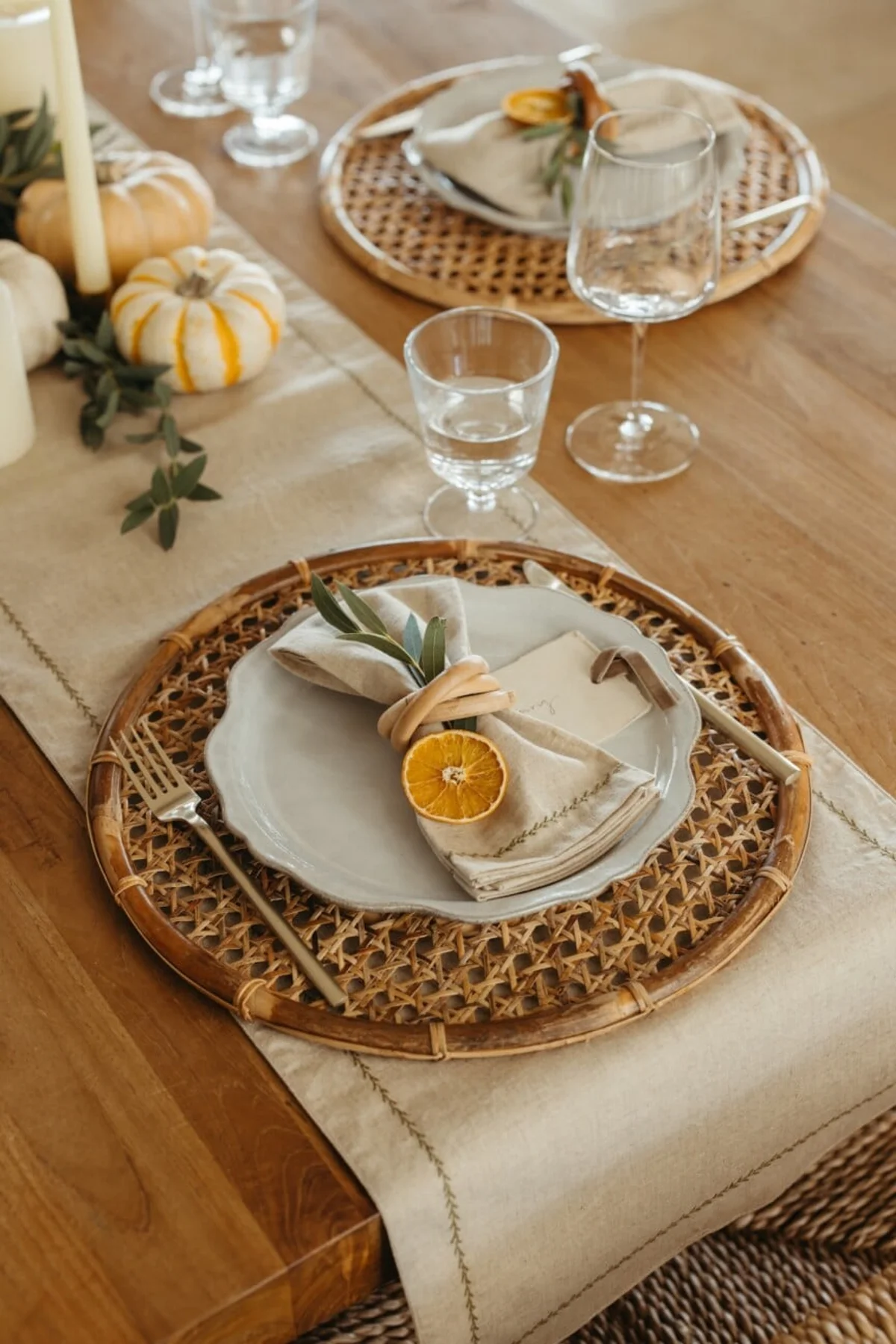
If you’re refreshing the table, buy pieces you’ll use for every dinner after, not just this one. Here’s the list I’d shop, at street prices:
- Oversized frayed linen napkins, set of 4 — $68
- Woven chargers, 2-pack — $18
- Handcrafted wood salad bowl — $100
- Pasta bowl, 38 oz — $9.99
- Ivory flatware set — $60
- Unscented pillar candles, 2-pack — $6
- Brass mini taper holder — $19.95
- Scalloped gold-rim serving platter — $25
- Flat place cards — $50 for 100
- Wooden napkin rings, 2-pack — $8
- Recycled wine glasses, set of 4 — $92
- Glass wine decanter — $24
That’s the whole kit. No discount codes, no sponsor — just what actually gets used.
Oven, Fridge, and Serving Shortcuts
- Mix your methods. Plan one dish for the oven, one for the stovetop, one for the slow cooker, and one that’s perfectly happy at room temperature.
- Move the drinks out of the fridge. Coolers with ice free up shelves for the food that needs them.
- Label everything. Sticky notes on empty serving dishes the day before mean anyone can help plate.
Dietary Needs Without Cooking Five Dinners
Ask when you invite, then build one shared menu that works for almost everyone. Roasted vegetables, potatoes, and cranberry sauce are naturally gluten-free, and thickening the gravy with cornstarch keeps it that way. Keep butter off one side for dairy-free guests, and add a vegetarian main that doubles as a side. A small card on each dish means guests don’t have to ask.
Plan for Cleanup Before Dinner
Future you will be grateful. Start with an empty dishwasher and an empty trash can. Fill the roasting pan with hot, soapy water as soon as the turkey is out. Set out containers for leftovers, and send guests home with plates. Refrigerate leftovers within two hours, and eat them within three to four days.
What to Skip (Yes, Really)
Give yourself permission to skip:
- A multi-course starter
- A second main
- A cocktail that needs five ingredients
- Matching everything, or polishing silver
- An elaborate centerpiece that blocks the conversation
What Guests Actually Remember
Here’s the truth: almost no one remembers whether the napkins were folded. They remember how the day felt.
- The welcome. A drink in hand within a few minutes of arriving, and somewhere to put their coat.
- The food flow. Hot food, an easy line, and nobody waiting an hour at the table.
- Comfort. A seat, the right temperature, and music at a volume where people can talk.
- Conversation. A host who’s actually there.
The Science, Simplified: hosting works like training. One giant day-long session beats nothing, but it’s always a bad idea. You split the volume across more days and more people, you schedule the big load (the turkey) first, and you build in the rest — the 30-minute turkey rest does the same job as a rest day. Do the same thing with a holiday dinner and the day takes care of itself.
So pour yourself something, pull up a chair, and let Thursday be about the people. You’ve got this.

Leave a Reply