
Two years, 7,000 nautical miles, 8 countries, 42 Greek islands — and we have never once missed the thousands of possessions we gave away or sold.
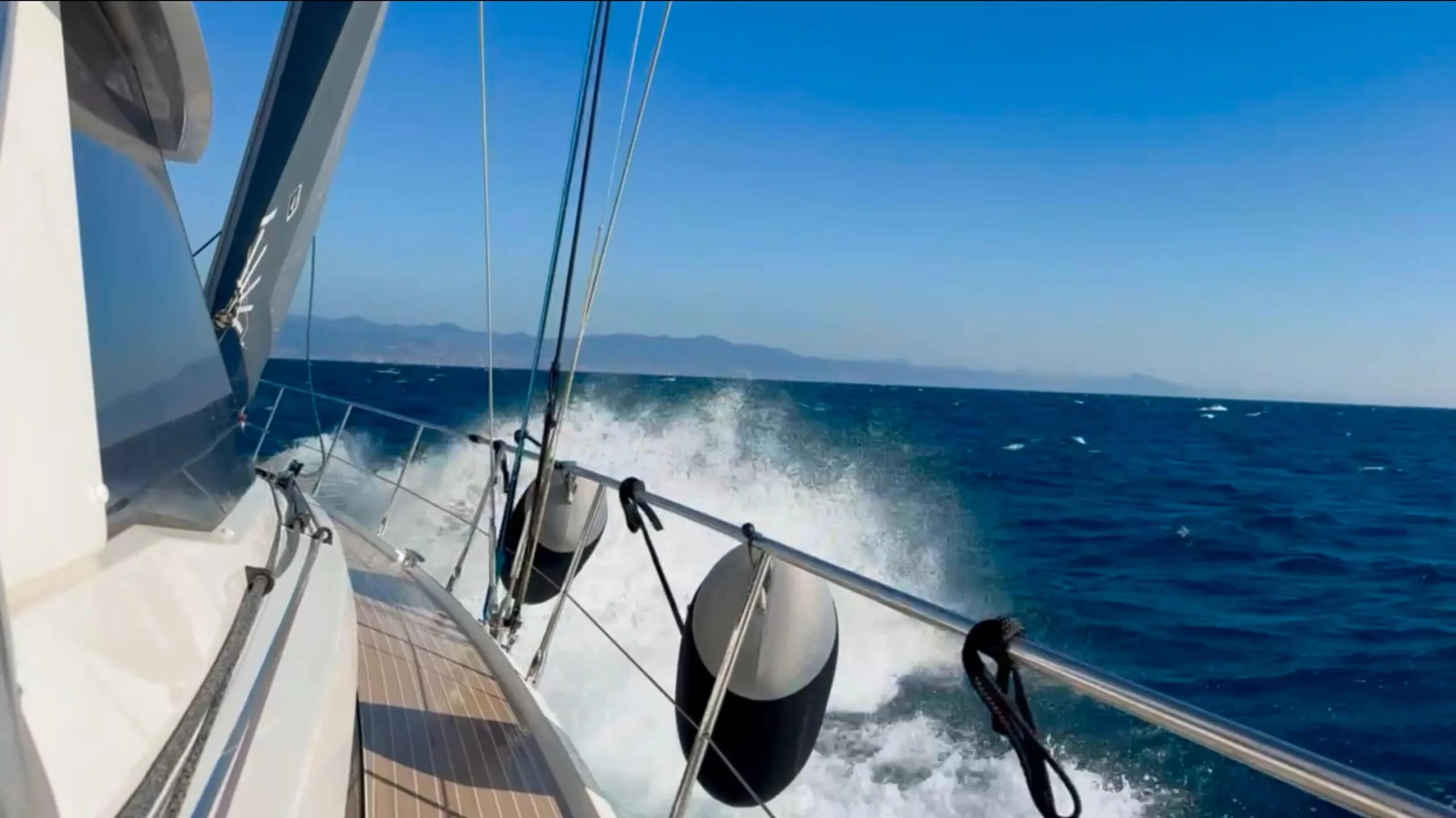
That’s the headline of our story. The unvarnished version is this: living aboard a 54-foot sailboat is the most active, strenuous, occasionally frustrating version of early retirement most people can imagine. There are no rocking chairs. There is, however, a 30-knot gust in the middle of a morning that rearranges your entire day, and a coffee in the cockpit that makes the whole thing worth it.
Before you ask: yes, we’re a couple. We go by The Admiral (me) and Sailor (my husband Peter) — nicknames from the old days of running our business together, and they stuck. We met 12 years ago with one shared goal: navigate to a place of financial independence, and build the personal growth to outgrow the scarcity mindset each of us carried from childhood. This is the wrap-up of a series I wrote on When Is Enough Enough — the short version of where that series landed: enough is not a number on a bank account. It’s a decision, made once and then re-made every single day.
The Life, Honestly
Our days don’t follow a plan. We wake up in a harbor that wasn’t on our routing spreadsheet, and the first question of the morning is usually “What town is this again?” Right now that’s a small seaside village outside Galaxidi, Greece, in the Gulf of Corinth — population under 2,000. That’s how we discover places: slowly, and usually without ever hearing of them in advance.
Yesterday the Mediterranean decided to show us its full range. Within five hours we went from flat calm, to the kind of smooth, glassy conditions sailors call champagne sailing, to 30-knot gusts and a 10-foot swell that had us hunting for the nearest anchorage. The lesson isn’t dramatic — it’s that flexibility is a muscle you train every day, same as anything else.
That’s the rhythm. We skip the big cruise-ship ports on purpose and look for the small fishing harbors and old Venetian town quays instead. We pick up new habits, new words, new foods. We make friends in a village and then leave them behind, which sounds worse than it is.

After two years on the water, our confidence keeps compounding. Every day hands you a new set of problems and, underneath them, a new lesson about what you’re actually capable of. Our relationship runs deeper for the daily partnership this life demands — more communication, more collaboration, less room for passive-aggressive silence in a 500-square-foot home.
The Money
Here’s the part people want to know about, so I’ll be specific without pretending to be your advisor. Our assets live in a deliberately conservative mix: mostly asset-backed real estate loans, so the principal holds its value even in a year when the dividends don’t come in as planned. Some sits in operating businesses we actually know — we have a personal relationship with the people running them, and that’s the confidence that matters. A healthy reserve sits in bonds and mutual funds, immediately available if we need it.
We don’t need a home run. We need solid, consistent singles and doubles — enough to cover our expenses and still grow our net worth faster than inflation.
(The usual caveat: this is how we structure things, not professional advice. Your situation, your risk tolerance, your advisor.)
Our spending follows a simple rule set, and we’ve written it down because it works:
- Seek value in functional things. We’re frugal on household basics — I cycle through the same practical sunshirts, because living in full sun every day means you need the function, not the brand.
- Invest in quality of life. If a piece of gear or a spare part makes the boat safer or the day easier, we buy it, price tag aside. On safety and comfort, we don’t cut corners.
- Splurge on moments. A full day at a 5-star spa after weeks of boat work is a real thing for us. So is a Michelin-rated dinner when the opportunity shows up. Once or twice a year, if we actually need to fly somewhere, we fly business class.
- Be generous with the people we love. We’d rather give a direct gift to a young person we’re mentoring than put our name on a building. A gift today removes an obstacle; a bequest is just a hope.
At the end of each month we reconcile and look for anomalies. A few times a year we pause to confirm we’re not outspending our income — or, more importantly, our assets. So far, the way we spend has reinforced the independence we built, decade after decade.
The Complications Nobody Mentions
Our home is a self-contained ecosystem floating in salt water: solar and a generator for power, lithium batteries for storage, a desalination plant for water, holding tanks for waste — all of it in one of the most corrosive environments on Earth. Hardly a week passes without a new repair project appearing. Spare parts, mechanical know-how, and self-sufficiency aren’t hobbies here. They’re the job.
Receiving a package is an exercise in patience. We have no shipping address. We can rarely pin down when we’ll be in a port, and even when we can, a package needs a willing human to hold it. Sometimes we just accept that we’ll never see it, and restart the whole process. For US mail we use a service that receives, opens, and scans — the nominal monthly fee is genuinely worth it.
Groceries are an improvisation. We can’t plan around a well-stocked store, and when we find one, the brands are local and the labels are in the local language. Meal planning starts with “what do we have to work with?” and ends with something we didn’t plan but are glad to eat.

The cost on relationships is the one that stings most. Thousands of miles and several time zones from close family, staying connected takes intention from both sides — and many friendships don’t survive the demand. That’s not a tragedy. It’s a filter, and it tells you quickly what’s real.
The Partnership
Living together in under 500 square feet, at sea for days and sometimes weeks, is not a typical relationship dynamic — and we’re frequently in high-stress situations where we depend on each other for actual safety. It works because our skills genuinely complement each other.
Sailor is the engineer. He’s the one who keeps the boat running — plumbing, electrical, diesel troubleshooting — and he builds dashboards that flag problems before they become failures. He studies sail trim constantly, and he’s a quiet advocate for open-source software, sharing the tools he builds with the cruising community. An email from a fellow sailor in a remote harbor, explaining how one of his tools helped through a bad passage, still makes him smile.
I handle provisioning, organization, and the daily work of making a small ship feel like a home. I plan the routes and the destinations, and I stay plugged into the cross-cultural work that keeps me sharp — a non-profit board, coaching women entrepreneurs, occasional speaking engagements from a rocking boat, which is a fun way to describe it.
We’re not perfect. Communication breaks down. We’re both committed to working through it, and we’ve each found our own outlets for the parts of ourselves the boat doesn’t give much room for.
The Two Couples at the Marina
The story I keep coming back to happened before we moved aboard, on the day we were selling our old sailboat. Two couples showed up, and they’ve stayed with me ever since.
The first was Ken, 75, who had been dreaming of exactly this life — a sailboat, living aboard, trips around the Pacific Northwest — for more than two decades. His balance was off, he had early signs of dementia, and he still wanted to go. His wife Fiona broke down in tears, holding my knee in the stateroom. “Thank you for telling Ken that this boat was already sold.” Some dreams, she was saying, go unfulfilled. Not because the dream was wrong, but because the trigger to act came more than 20 years late.
The second couple, Terry and Barb, both 76, bought their boat brand new 40 years earlier — when they could barely afford it. They’ve been sailing and living their dream ever since, and they raised their son aboard. They’ll tell you honestly that they’re less nimble now, and that a new boat would be a steep learning curve at their age. But they know their boat perfectly, they’ve adapted to their bodies, and when we met them they were still enjoying every day of it.
Two couples. Similar dreams. One made it happen. One was still holding onto hope.
The Science, Simplified
Strip the story down and the mechanism is simple. We made a commitment to a date, not a number — a placeholder of 10 years to frame the decision of not keeping any possessions in the US — and then we did the work every day to earn that commitment. The doubt still shows up. The scarcity voices from childhood still whisper. But a commitment with a date forces a decision, and a decision is the only thing that beats a number, because a number can always be higher. Enough is a continuously chosen mindset, not a one-time box to check.
Two years in, the growth from the challenge outweighs the hardship — and at this pace, 10 years may not be enough, which we’re fine with.
Try This
You don’t need a boat to run the experiment. Pick one category of “enough” — a number, a role, a project — and put a date on it instead of a target. Tell one person who’ll hold you to it. Then live inside the date for 30 days and watch what your actual life feels like, separate from what your balance sheet says it should feel like. That’s the whole method. It’s how we did it. Fair winds and following seas.



Leave a Reply