
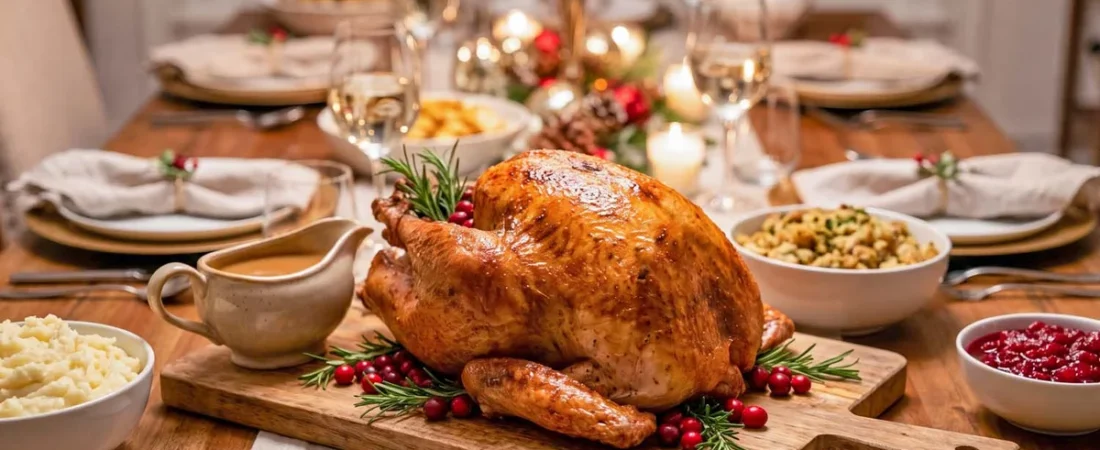
The turkey is carved, the table is cleared, and the platter is still sitting there while everyone finishes dessert. If it hasn’t been held hot the whole time, the clock on that bird started the moment it left the oven — not the moment it hit the table.
The short answer: two hours at room temperature, per the USDA. If the room is above 90°F, that drops to one hour. Past the limit, we’d discard it rather than reheat it, because reheating may not make it safe.
The 2-Hour Rule, and Where It Comes From
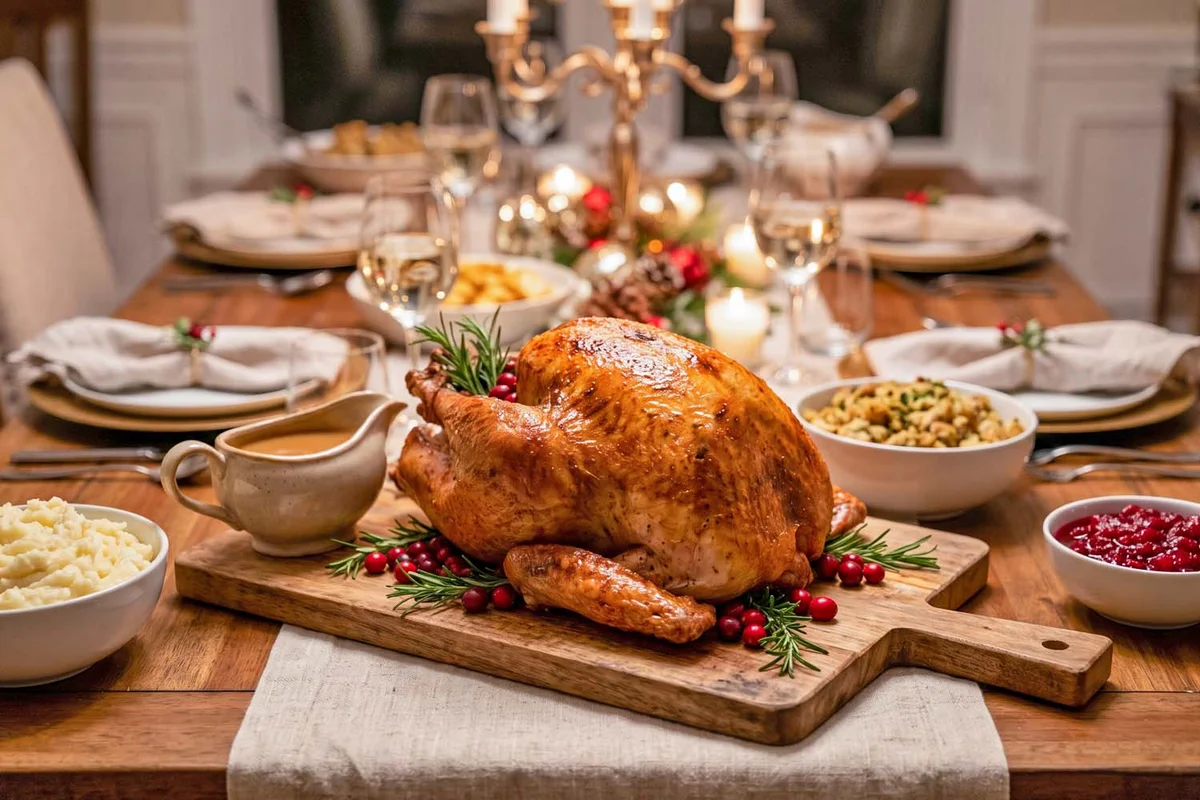
USDA, the FDA, and several university extension services all land on the same number. Cooked turkey is a perishable food, and perishable foods shouldn’t sit out of the refrigerator for more than 2 hours. If the temperature is above 90°F, the limit is 1 hour. Unless the turkey is being held above 140°F, the clock runs from when it was cooked.
The reason is what USDA calls the Danger Zone: bacteria grow fastest between 40°F and 140°F, and can double in number in as little as 20 minutes. That’s why the limit isn’t a suggestion. It’s a window before bacterial load climbs to the point where even cooking may not fully protect you.
When does the clock actually start?
Here’s the part most people get wrong. USDA says to store leftovers within two hours of cooking. Nebraska-Lincoln Extension adds that the limit includes time on the table during the meal — not just time on the counter afterward.
Nebraska-Lincoln’s turkey fact sheet recommends letting a turkey stand for 20 minutes before carving for the best quality. Add 20 minutes of carving, and the bird has been out for about 40 minutes before anyone sits down to eat. If the turkey comes out at 3:00 p.m., I’d aim to have the leftovers in the refrigerator by 5:00 p.m. That’s not paranoia. That’s just doing the math the USDA is asking you to do.
Hot Day, Picnic, or Patio Dinner
One hour. If the temperature is above 90°F, every source I checked — USDA’s Danger Zone page, USDA’s Kitchen Companion handbook, the FDA’s buffet guidance — says the safe window shrinks to one hour.
For a backyard barbecue or a patio Thanksgiving in warmer weather, here’s what I tell my clients: carve only what you’ll serve in the first round, and keep the rest in the refrigerator until it’s needed. Don’t put the whole platter out and hope for the best. Hope is not a food-safety strategy.
Can Turkey Sit Out Overnight?
No. Overnight is far past two hours, and none of the USDA or FDA pages I read allow an exception. Minnesota’s Department of Health says turkey, stuffing, and gravy left out at room temperature for longer than two hours should all be thrown away. I’d discard all three, even if the turkey looked and smelled perfectly fine.
It doesn’t help that the turkey was fully cooked. A cooked bird is a ready-made medium for bacteria the moment it enters the Danger Zone — and overnight gives them plenty of time to get comfortable.
Buffet and Dinner-Service Situations
The same two hours apply, counted from when the turkey first comes out. The FDA’s buffet guidance says hot foods should be held at an internal temperature of 140°F or warmer, and its advice for refills is to replace nearly empty serving dishes with freshly filled ones rather than topping off an old platter.
The practical version: put a smaller platter of carved turkey on the table, keep the rest either hot at 140°F or above or in the refrigerator, and swap platters as they empty. Each platter stays well inside the two-hour window, and you avoid the problem entirely.
Keeping Turkey Warm for Longer
Yes, as long as it actually stays hot. The FDA’s rule excepts food you’re keeping hot or cold, and it says hot foods on a buffet should be held at 140°F or warmer. USDA’s Kitchen Companion handbook says the same: if you aren’t serving right away, keep it at 140°F or above.
Here’s the catch. The FDA warns that some warmers only hold food at 110°F to 120°F — warm enough to feel reassuring, cool enough to be inside the Danger Zone. Whether you’re using a warming tray, a slow cooker, or a covered pan in the oven, check the turkey itself with a food thermometer. If it has cooled into the 40°F to 140°F range, it’s no longer being held hot, and that time counts against the two hours.
Can You Reheat Turkey That Sat Out Too Long?
I wouldn’t count on it. Nebraska-Lincoln Extension says reheating food that was forgotten on the counter may not make it safe, because some bacteria form a heat-resistant toxin that cooking can’t destroy. Reheating to 165°F is the right move for leftovers that were refrigerated in time. For turkey that sat out too long, I’d discard it.
And no, don’t taste it to find out. USDA’s Kitchen Companion handbook says you can’t see, smell, or taste these pathogens. A turkey that looks and smells normal can still be unsafe. The clock and the thermometer are the test — not the turkey.
Storing Leftover Turkey
Quickly, and in pieces. USDA’s Turkey Basics page says to cut the turkey into smaller pieces and refrigerate it. Remove all the stuffing from the cavity and refrigerate it separately. Put potatoes, gravy, and vegetables in shallow containers.
FoodSafety.gov says to refrigerate or freeze leftovers as soon as possible, even if they’re still steaming. Divide them into smaller portions in covered shallow containers so they cool quickly. Nebraska-Lincoln Extension says food in each container should be 3 inches deep or less. I’d carve the meat off the bones and portion it before it goes in — it makes the next four days much easier.
How Long Does Leftover Turkey Last?
Three to four days in the refrigerator, per USDA. The Thanksgiving page says to use or freeze leftovers within four days of when you first cooked them. I’d count from the day the turkey was cooked, not the day it went into the fridge.
For longer storage, freeze it. USDA’s Turkey Basics gives four months for plain slices or pieces, and six months for turkey covered with broth or gravy. Cooked poultry dishes, stuffing, and gravy are good for four to six months in the freezer. Nebraska-Lincoln Extension notes that frozen leftovers are safe indefinitely at 0°F, but they can lose moisture and flavor over time — so the ranges are about quality, not safety.
Reheating Leftover Turkey
To 165°F, measured with a food thermometer. USDA’s Turkey Basics page says to reheat thoroughly to 165°F or until hot and steaming, and FoodSafety.gov says to measure it with a thermometer. Bring gravy to a rolling boil when you reheat it.
One thing I keep telling people: reheat only what you’ll actually eat, and keep the rest cold. Reheating the whole leftover pan every time it gets touched is how you end up with dry, overcooked meat that no one wants.
Can Turkey That Sat Out Make You Sick?
Yes. The CDC estimates that Clostridium perfringens causes nearly 900,000 foodborne illnesses in the United States each year, and it lists poultry such as turkey and chicken, as well as gravy, among the foods commonly linked to it.
CDC says the bacteria make spores with protective coatings, and that after you eat contaminated food the bacteria can make a toxin in your gut that causes diarrhea. Outbreaks most often involve food cooked in large batches and held at unsafe temperatures, between 40°F and 140°F — and most happen in November and December. North Dakota Health and Human Services says symptoms begin 6 to 24 hours after eating and usually last less than a day.
This is general information, not medical advice. CDC says to contact a healthcare provider for diarrhea or vomiting lasting more than two days, bloody stool or urine, or signs of dehydration. If something feels off, see a qualified professional rather than toughing it out.
What About the Rest of the Table?
The turkey is rarely alone, and the sides have their own clocks. The same two-hour limit applies to stuffing and gravy — both are perishable foods. USDA says to remove the stuffing from the cavity and refrigerate it right away, and to keep gravy in shallow containers. Reheat gravy to a rolling boil.
If you’re serving ham alongside, deli turkey for sandwiches the next day, or any of the other classics, the two-hour rule applies to all of them as perishable foods. The clock doesn’t care what the dish is called.
Signs something is wrong
These are the ones that matter:
- Turkey out more than 2 hours, or more than 1 hour above 90°F. That’s the rule, and no other sign is needed.
- Turkey left out overnight, along with any stuffing or gravy that sat beside it.
- Turkey kept warm that fell below 140°F and then sat. Count that time against the two hours.
- Leftovers kept past 3 to 4 days in the refrigerator, counted from the day it was cooked.
- Visible mold. USDA says to discard moldy cooked leftovers.
Things that don’t automatically mean trouble
- Steam rising from hot turkey as it goes into the fridge. FoodSafety.gov says leftovers can go in while they’re still steaming.
- Turkey held at 140°F or above for the whole meal. The FDA’s rule excepts food you’re keeping hot.
- Drier or firmer meat after reheating. That’s a quality change, not a safety one — though it doesn’t replace the timing rules.
Quick Reference
Here’s the whole article in one table. Print it, tape it to the fridge, whatever works.
| Situation | What to do |
|---|---|
| Out for 1 hour in a 70°F room | Fine, assuming it was cooked and handled safely. Refrigerate it or keep it at 140°F or above before the 2-hour mark. |
| Out for exactly 2 hours | At the limit. Refrigerate it now, in shallow covered containers. |
| Out for 3 hours | Discard it. That’s past the 2-hour limit. |
| Out for 90 minutes at a 95°F picnic | Discard it. Above 90°F the limit is 1 hour. |
| Left out overnight | Discard it, along with the stuffing and gravy that sat with it. |
| Unheated on the buffet for 2.5 hours | Discard it. The FDA says to throw out perishables left at room temperature more than 2 hours. |
| Held in a warmer at 140°F or above the whole meal | Within the hot-holding rule if a thermometer confirmed 140°F or above the whole time, per the FDA. Quality may have suffered. |
| Sat out 4 hours, then reheated to 165°F | Discard it. Reheating may not make it safe, per Nebraska-Lincoln. |
| Refrigerated within 90 minutes of cooking | Within the 2-hour limit, assuming it was cooked and handled safely. Use it within 3 to 4 days of cooking. |
| Rested 20 minutes, carved for 20, then sat 90 minutes on the table | Discard it, unless a thermometer showed 140°F or above the whole time. That adds up to 130 minutes from the oven. |
| Hot, still steaming, straight from the table | Fine to refrigerate right away. Cut it up and use shallow covered containers. |
| Leftover turkey cooked 5 days ago | Discard it. That’s past the 3 to 4 day limit. |
| Plain turkey slices frozen for 6 months | Safe if they stayed frozen at 0°F, per Nebraska-Lincoln, but past the 4-month mark for plain slices, so quality may have declined. |
FAQ
Does the two-hour limit include resting and carving time? Yes. USDA says to store leftovers within two hours of cooking if they’re not being held above 140°F. I’d start the clock when the turkey comes out of the oven.
Can you tell by the smell if turkey sat out too long? No. You can’t see, smell, or taste these pathogens. Go by the clock and the thermometer, not the turkey.
Why do some sources mention four hours for turkey? Food establishments may hold certain foods without temperature control to hold some foods without temperature control for up to four hours, but only under written procedures and time marking. That’s a food-service procedure, not advice for a turkey dinner at home. For home leftovers, USDA and FDA consumer pages say 2 hours, or 1 hour above 90°F.
Should you let turkey cool before refrigerating it? No. FoodSafety.gov says leftovers should go in the refrigerator or freezer as soon as possible, even while they still have steam or heat coming off of them.
Does stuffing follow the same rule? Yes. Minnesota’s health department says turkey, stuffing, and gravy left out longer than two hours should all be thrown away. USDA says to remove the stuffing from the cavity and refrigerate it.
Does gravy follow the same rule? Yes. It’s a perishable food, so the two-hour limit applies. Refrigerate it in shallow containers and bring it to a rolling boil when reheating.
Can you leave cooked turkey in the oven after turning it off? I found no USDA guidance on a turned-off oven specifically. Once the oven cools, it’s no longer holding the turkey at 140°F, so I’d count that time against the two hours and check with a thermometer.
Does covering turkey with foil make it safe to sit out? I found no USDA guidance that foil changes the time limit. The limit is about temperature, and only a thermometer reading of 140°F or above shows the turkey is being held hot.
Does a cool room, porch, or garage count as refrigeration? I’d say no. The Danger Zone starts at 40°F, so a cool room above 40°F is still inside it. Use the refrigerator.
Can you use a turkey carcass for stock if it sat out overnight? I’d discard it. Simmering heats it, but reheating may not make food that sat out safe because some toxins survive cooking.
How long can turkey rest before carving? Nebraska-Lincoln Extension says 20 minutes, for the best quality. That time counts toward the two hours unless the turkey is being held hot, so plan carving and serving to follow it promptly.
The Science, Simplified
The whole thing comes down to temperature and time. Bacteria that make people sick grow fastest between 40°F and 140°F, and they can double in 20 minutes. Two hours at room temperature is the window where that growth hasn’t gotten dangerous yet. One hour if it’s a hot day. Hold the turkey at 140°F or above and the clock effectively pauses. Let it cool below 140°F and the clock starts running again. That’s the entire rule, and it’s the same one the FDA and USDA use for every perishable food on your table — turkey, stuffing, gravy, the works.
Next time you’re at the table, keep a food thermometer in your pocket and do the math out loud. It takes ten seconds, and it saves a whole lot of guesswork.

Leave a Reply