If you’ve ever stared at your own work and wondered whether you’re correcting it into something boring, you’re not alone. I caught myself doing it last month — right in the middle of a painting, second-guessing every light and shadow shape, checking whether the likeness was good enough, whether it read as that specific dog and not just a similar one. I was so busy fixing that I was nearly fixing out everything that made the piece mine.
The short answer to the question I’d been carrying: yes, keep improving your fundamentals — but don’t sand off your fingerprint on the way.
Most of the time, when I’m doing something physically engaging that lets my mind wander — gardening, cleaning, walking — I put on music or a podcast. But now and then I give my head quiet and see what bubbles up. A few weeks ago I finally finished a marathon audiobook biography of Van Gogh, and he’d been on my mind a lot.
The corrections that never fully corrected
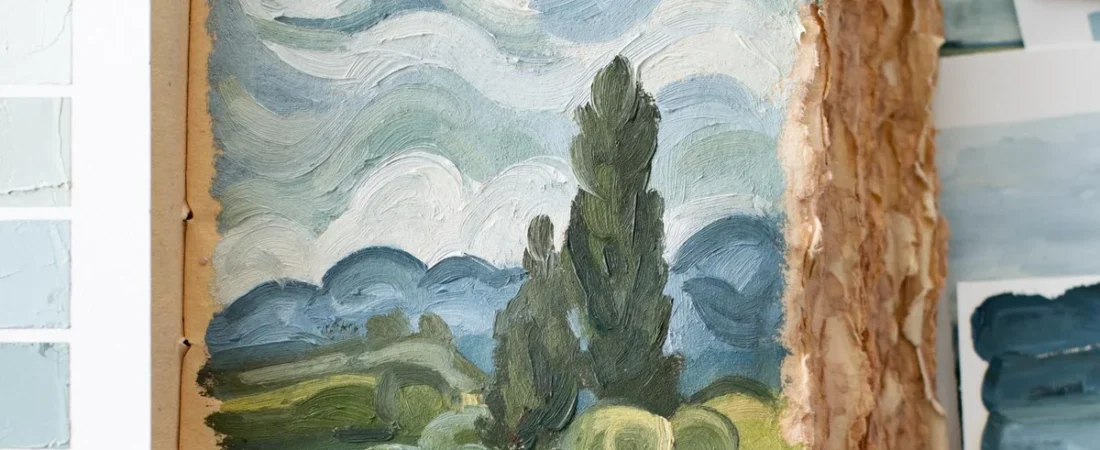
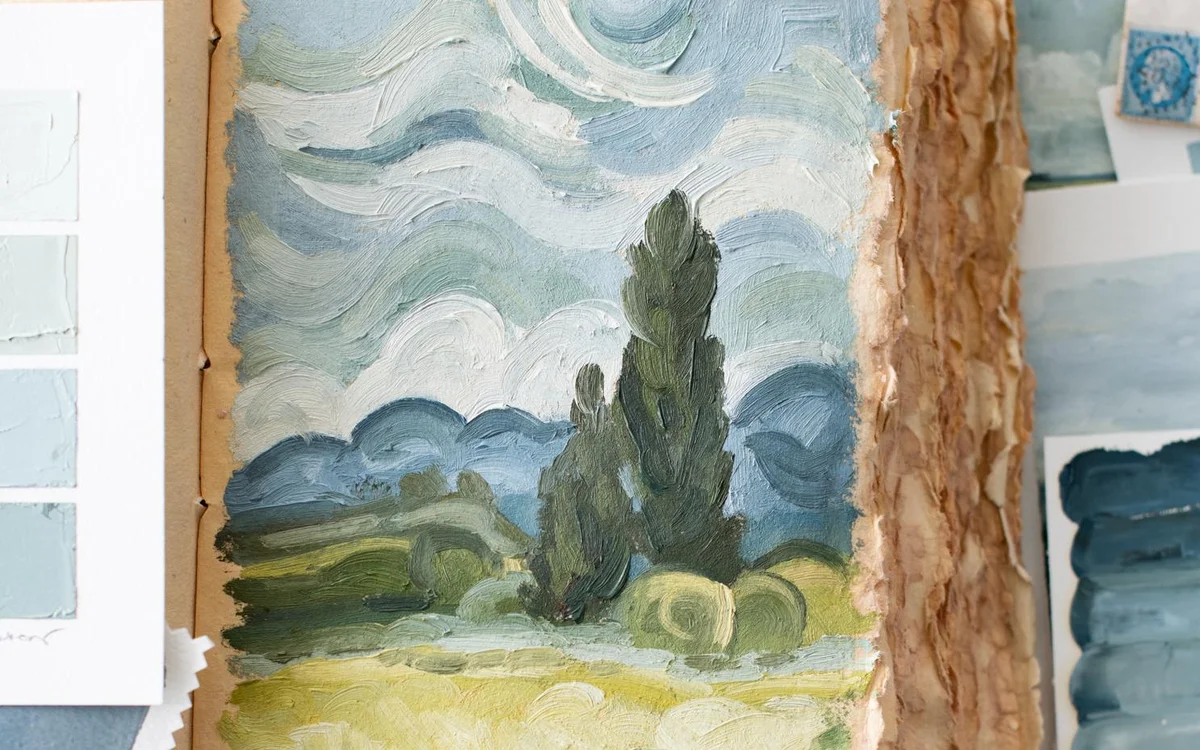
Van Gogh took real criticism for his out-of-proportion figures, clunky faces, and wonky buildings. He knew it was a struggle and practiced fanatically to improve. He moved onto the grid method for accuracy, and because he painted from life, he used a large wooden perspective frame — a grid made from taut string — that he hauled around with him, set in front of his subject, and used to render more accurate proportions. It did improve his proportions. But even in later work, created long after he adopted the frame, the figures still look off. The faces don’t read as realistic faces. A tree bends in an unnatural way. Clouds swirl. Furniture looks like it shouldn’t be able to stand upright.
It’s easy to look back and see that the very imperfections he was so distraught over were actually a strength — a hallmark, the thing that makes his work stand apart.
Your tendencies are not all bugs
Here’s where it gets personal. I stress about my own draftsmanship, too. It’s the weakest part of my process, and I often don’t trust myself with it. I practice. I use tools to check for accuracy and double-check my drawings, to speed through the part that makes me antsy. But I still feel self-conscious about it.
I have a known, repeatable tendency: when I draw freehand without measuring, I elongate things. I made cups and vases taller and skinnier than they actually are — I know this because I always have to correct it, make things a little wider and a little shorter. In landscapes, I pull the background too far forward and lose the illusion of depth. I’m aware of it. I fight it, try to fix it — and I still do it.
The big part of me, the part that always wins, sees all of those tendencies as flaws, errors, signs that I’m still far from being a great artist. But a smaller part keeps asking: what if I’m fighting against the very things that make my work mine? What if I left the cup a little too tall and too skinny? What if I leaned into the flattened landscapes instead of apologizing for them?
Picasso was an excellent draftsman — a prodigy. It’s the faces he drew entirely wrong that made his name in the art world.
It goes beyond the studio
The same thing happens everywhere. AI-powered grammar software “fixes” my writing tendencies, and because they’re constantly underlined in blue I can see them more clearly than I ever could before — not grammatical errors, just things that could be said in a cleaner, more concise way. My fountain pen never interrupts my creative flow to tell me I could have written something more precise. Is the software stripping away what makes my writing mine?
It extends well beyond art: social media algorithms push us toward sameness, real estate specialists tell us to paint our walls white or beige, clothing companies dictate what is stylish. Striving for conventional perfection is easy and natural. But I think we’re collectively stripping away some of the personality that makes things unique, quirky, distinct, and even genuine.
Here’s what I tell my clients, in the gym and out of it: fix the flaw, keep the fingerprint. The research and the masters agree on the fundamentals — practice the accuracy, check your proportions, build the base. But the practical part is knowing where to stop correcting, and that you’ll only find out by letting a little of yourself show.
The Science, Simplified: Fundamentals matter — everyone from Van Gogh to a beginner lifter knows the base skills need work. But improvement is not homogenization. The part of your output that is uniquely yours is the part worth protecting. Practice the fundamentals on purpose, then give your natural tendencies room to appear, and explore them instead of erasing them.
I want to keep growing as an artist. I want places to look like real places and portraits to have a strong likeness. I just want more room for my natural tendencies to make their appearance — and a little more room in the creativity of others, too, for their personality and their imperfections.
Try this one: next time you correct something, ask yourself if you’re fixing a flaw or erasing a fingerprint. If it’s the second one, leave it in. And I hope you’ll do the same for the work of the people around you.



Leave a Reply