
HENDERSON COUNTY, North Carolina — The rain poured steadily as I crouched beside a jagged rock face on a remote mountainside, peering into the narrow cracks that could hide one of the rarest amphibians on Earth. I was looking for the Hickory Nut Gorge green salamander, a tiny, finger-length creature cloaked in black with splashes of mint green, perfectly camouflaged against lichen-covered stone.
I had been here before, nearly a year ago, reporting on southern Appalachia’s remarkable salamander diversity. With over a hundred species thriving in this region, western North Carolina near Asheville holds more salamander species per square mile than anywhere else in the world. But even then, some species were already on the edge of survival.
The Hickory Nut Gorge green salamander was one of them. Found only in a single valley southwest of Asheville, their population had been reduced from tens of thousands to just a few hundred due to logging, development, and other human pressures. By 2021, the state of North Carolina listed them as endangered. By 2024, federal authorities acknowledged that federal protections might soon be necessary.
And then Hurricane Helene struck.
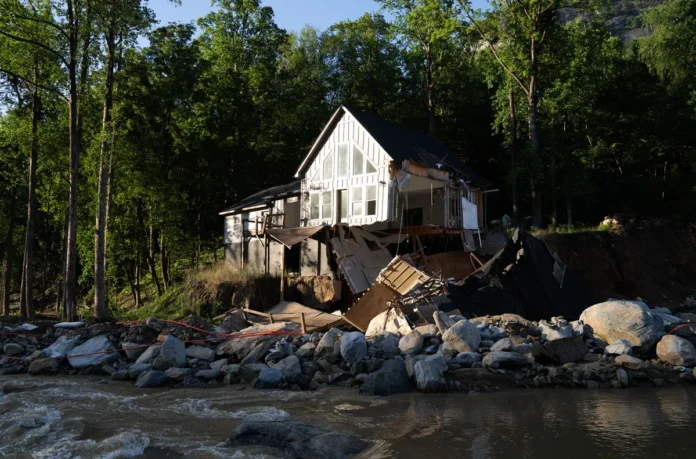
The late September storm left devastation in its wake: lives lost, homes obliterated, entire neighborhoods underwater. The wildlife of southern Appalachia fared no better. Torrential flooding, mudslides, and deforestation wiped out critical habitat, including parts of the gorge where these salamanders breed. Some areas looked as if they had been clearcut overnight. For species already teetering on the brink, the storm was catastrophic.
This past June, I returned to witness an urgent rescue operation. Scientists were working to save the remaining greens before their fragile population disappeared entirely. Floods had stripped trees, eroded soils, and altered the microhabitats that these lungless salamanders rely on to breathe through their skin. Without the protective shade of the forest canopy, their rock crevices dry out, and the insects they feed on — ants and beetles — vanish along with the trees.
The damage was extensive. Experts estimate that Helene destroyed roughly 30 percent of the greens’ habitat in the gorge, and the North Carolina Forest Service reported that over a quarter of forested land in affected counties suffered severe damage. Aerially, the gorge bore a gaping scar where the breeding population once thrived.
To counter this, researchers like JJ Apodaca, executive director of the Amphibian and Reptile Conservancy, are now attempting to build a lifeline for the species. With permits in hand, Apodaca and his team have been capturing a small number of individuals to bring into captivity, creating a controlled population that can survive even if the wild habitat fails. The goal is modest yet critical: collect roughly 25 individuals — enough to sustain a breeding program without further jeopardizing the remaining wild population.
Late one afternoon, thunder rumbled overhead as Apodaca and I navigated the gorge. The easiest route took us through an area flattened by floodwaters, muddy and littered with rocks the size of cars. Crossing the Broad River, now chocolate-colored from sediment, we trudged uphill toward Party Rock, a granite outcropping favored by the greens.
Once shaded by a forest canopy, the rock now baked in the sun, threatening to desiccate any salamander hiding within its cracks. For hours, Apodaca and I scoured the crevices with flashlights. Every twitch of movement sent a jolt through me — only to reveal giant camel crickets. Some of the greens had been rescued already; those left in the wild were hard to find, perhaps too few to survive the season.
Back at the North Carolina Zoo, the salvaged salamanders reside in small, unassuming plastic containers lined with moss and damp paper towels. These modest enclosures hold extraordinary potential: the continuation of an entire species. Among the 15 rescued salamanders, four females were already gravid, carrying eggs that could produce the next generation. Using a miniature ultrasound machine, the team confirmed dozens of eggs inside each female.
The hope is that the captive population will grow, and eventually, some individuals may be returned to the gorge — if suitable habitat remains. Yet, uncertainty looms. Climate models predict stronger hurricanes and more intense rainfall events in the coming years, raising the stakes for these fragile amphibians.
So why does saving a few green salamanders matter? Because, as Apodaca explained, they are more than just tiny creatures tucked away in remote crevices. They play a pivotal role in their ecosystem, controlling insect populations and helping maintain forest health — an ecosystem that provides water, supports wildlife, and sustains local communities. In a way, these salamanders are little climate guardians.
Ultimately, this mission is also about respect for life. “You either relish in nature and view the world as having a right to exist beyond us, or you don’t,” Apodaca said. For now, in the shadow of Hurricane Helene’s destruction, a small group of scientists is racing against time to ensure that the Hickory Nut Gorge green salamander does survive — a quiet yet profound act of preservation in a changing world.