I dropped my daughter off at college last week, and our goodbye was nothing like I imagined. No long hugs. No tears. No standing in the dorm doorway trying to memorize her face.
Instead: a quick hug, an “I have to go!” — she was already late for sorority recruitment orientation. And just like that, she was gone.

The next morning, I got a text. She’d been dropped by two sororities where she was a legacy — based on a video she’d submitted months before ever stepping onto campus.
My reply was simple: “I’m sorry. It’s a numbers game. Focus forward. You still have 14 houses to visit.”
My internal reply?
What the heck?
I’ll admit it — I was annoyed. How could my own sorority, an organization that talks about membership not as four years but as a lifetime, not even invite her back for a single in-person visit?
Curiosity won. I went to the national site, read the mission statement, read the values — and then found that in 2020, the sorority had eliminated preferential treatment for legacies. Fair enough. Times change.
But I also stumbled on their page encouraging alumni to include the sorority’s foundation in their legacy giving. Apparently, they may not be that interested in my legacy daughter — but they’re still interested in my legacy gift.
Okay then. I gave myself that one moment of irritation, and moved on.

Not your people. March on.
And that’s exactly what my daughter did.
For the next two days, she visited 14 houses. Texts about kind girls, great conversations, houses she could picture herself in.
Meanwhile, she was walking miles around campus in dresses and heels, in heat that felt well over 100 degrees, trying to keep her makeup from melting off her face while making conversation with hundreds of complete strangers.
Then came the second round of cuts.
This one hurt more. Some of the houses she’d really liked were gone. She was disappointed. I was disappointed for her.
But she still had seven houses waiting.
So she had a choice: walk into those houses carrying the disappointment of the ones that didn’t want her — or hold her head high, swallow her pride, put a smile on, and give the women standing in front of her a real chance.
She chose the latter.
The work nobody sees on TikTok
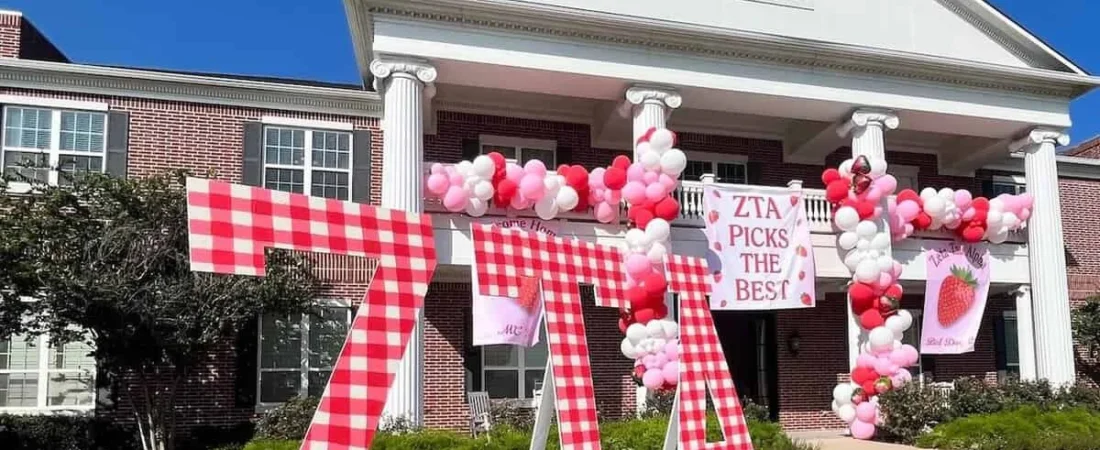
And maybe that’s the part of recruitment we don’t talk about enough. Social media has turned Rush into a spectacle — coordinated outfits, choreographed dances, matching sneakers, seemingly perfect college girls. But there’s an enormous amount of work behind the scenes.
Sorority women often return to campus well before classes begin. Recruitment is planned for months: recruitment chairs, philanthropy teams, marketing and social media teams, logistics, decorations, songs and dances to learn, conversations to practice, schedules to coordinate, and hundreds — sometimes thousands — of potential new members moving through houses.
It’s essentially a massive student-run organization putting on one of its biggest events of the year. And yes, the dancing is fun to watch. But that’s not all these organizations do. Across this country, sororities and fraternities raise significant money and awareness for children’s causes, cancer research, literacy, and people with disabilities. Students are learning to organize events, manage budgets, lead teams, fundraise, and work toward something larger than themselves.
Does that mean the Greek system is perfect? Of course not. Does recruitment sometimes feel superficial? Absolutely. Can the process feel unfair? Without question. But here’s the part I keep coming back to: life is unfair sometimes.
My daughter waited for the verdict
Here’s the coaching part I wish every parent read before the first cut list drops.
Maybe our job as parents isn’t to eliminate every unfair experience our children encounter. Maybe our job is to teach them what to do when one happens.
I’ve watched parents online get furious over recruitment. “This isn’t fair.” “This system is terrible.” “My daughter deserved that house.” “She did everything right.” I understand the instinct — when our kids hurt, we hurt. But I wonder when our generation decided that disappointment was something our children should never have to experience.
Teams make cuts. Auditions make cuts. Competitive clubs make cuts. Internships reject applicants. Colleges reject applicants. Companies reject applicants. Sometimes someone else gets the spot — even when your kid worked incredibly hard and did nothing wrong. That is life. Sometimes the spot just goes to someone else, and everything that comes next is up to you.
The difference with sorority recruitment is that much of it now happens publicly, wrapped in matching outfits and blasted across TikTok and Instagram. That visibility makes the rejection feel bigger than it is.
But rejection isn’t new. And learning how to handle it is one of the most important skills a young person takes into adulthood.
As I write this, my daughter still doesn’t know how her story ends. She’s spent the last two days having deeper conversations and making new connections. Now she waits to find out which houses, if any, she’ll visit for Preference Round. She could end up with two houses she loves. She could end up with one. She could get a bid she’s thrilled about. Or she could get the phone call telling her she isn’t receiving a bid at all.
I desperately hope that doesn’t happen. I’m her dad. Of course I want this to work out.
But if it doesn’t, I know what I’ll tell her.
You get to be sad. You get to be disappointed. You can even say, “This really stinks.”
And then? You march on.
You leave your dorm room. You introduce yourself to someone new. You join a club. You go to class. You find your people somewhere else. Because the real goal of sending our kids to college isn’t to make sure nothing bad ever happens to them. It’s to send them into the world knowing that when something bad does happen, they can handle it.
Either way, she won this week
Maybe she gets a bid. Maybe she doesn’t. Either way, this week has already taught her something valuable.
She put herself out there. She faced rejection. She walked back into another house with her head held high. She kept talking. She kept trying. She kept marching forward.
And as hard as that can be for a dad to watch, I think that’s exactly what growing up is supposed to look like.
The Science, Simplified: Researchers who study how people weather rejections keep landing on the same practical takeaway as every coach who’s ever cut a roster: the skill isn’t feeling nothing — it’s giving yourself a limited, honest window to be disappointed, then acting like the outcome is temporary and fixable. Fairness wins out eventually. The ones who keep showing up, in the right room, get the call back.



Leave a Reply